
Your lettuce crop looked perfect yesterday. Today, half the leaves are yellowing and growth has stalled. Your tomatoes were thriving last week, but now they’re showing classic signs of nutrient burn. Sound familiar? These scenarios play out in hydroponic operations worldwide, and in most cases, they’re completely preventable through proper nutrient solution monitoring.
For commercial hydroponic growers, nutrient solution management represents the difference between profitable harvests and costly failures. Unlike soil-based agriculture where nutrient imbalances develop slowly, hydroponic systems can shift from optimal to catastrophic within days—or even hours. The concentrated nature of hydroponic solutions means small changes in concentration or pH can have dramatic effects on plant health, growth rates, and ultimately, your bottom line.
Yet many growers treat nutrient monitoring as a secondary concern, focusing on visible plant symptoms rather than the water chemistry that drives plant performance. This reactive approach leads to reduced yields, increased crop losses, and higher input costs as growers struggle to correct problems after they’ve already damaged crops.
The most successful commercial hydroponic operations understand that nutrient monitoring isn’t just about preventing problems—it’s about optimizing every aspect of plant growth to maximize productivity and profitability. These growers use precise monitoring protocols to fine-tune their systems, achieving yields that can exceed soil-based production by 300-500% while using 90% less water.
The Foundation: Why Monitoring Makes or Breaks Your Operation
In hydroponic systems, your nutrient solution is literally your soil, your irrigation water, and your fertilizer program all rolled into one. Monitoring ensures optimal plant growth through precise nutrient delivery, preventing imbalances while enabling efficient resource use. This precision is impossible to achieve without consistent, accurate monitoring.
Unlike traditional agriculture where soil acts as a buffer against rapid nutrient changes, hydroponic systems provide no such safety net. Plants in hydroponic systems depend entirely on the nutrient solution for their mineral nutrition, making solution quality the primary factor determining plant health, growth rate, and final yield.
The economic impact of poor monitoring extends far beyond immediate crop losses. Preventing nutrient imbalances through proper monitoring enables efficient resource use and can significantly increase yields. Conversely, nutrient imbalances can reduce yields by 20-50% while increasing input costs through wasted fertilizers and corrective treatments.
Concentration drift represents one of the most common and costly problems in hydroponic operations. As plants uptake nutrients and water evaporates, the remaining solution becomes more concentrated, potentially reaching levels that damage or kill plants. Without regular monitoring, this concentration creep can destroy entire crops before symptoms become apparent.
Nutrient ratios also change over time as plants preferentially uptake certain elements while leaving others behind. Nitrogen might be depleted while phosphorus accumulates, creating imbalances that limit growth even when total nutrient levels appear adequate. Only through regular monitoring can growers detect and correct these subtle but significant changes.
PH drift affects nutrient availability even when concentrations remain optimal. As pH moves outside the ideal range, plants lose the ability to uptake certain nutrients, creating deficiency symptoms despite adequate nutrient levels in the solution. Advanced monitoring enables growers to maintain optimal nutrient levels and increase yields significantly.
Water quality changes from source water fluctuations, equipment problems, or contamination can rapidly compromise entire systems. Municipal water systems may change treatment protocols, wells may encounter different mineral deposits, and storage systems may develop bacterial contamination. Regular monitoring provides early warning of these changes before they affect plant health.
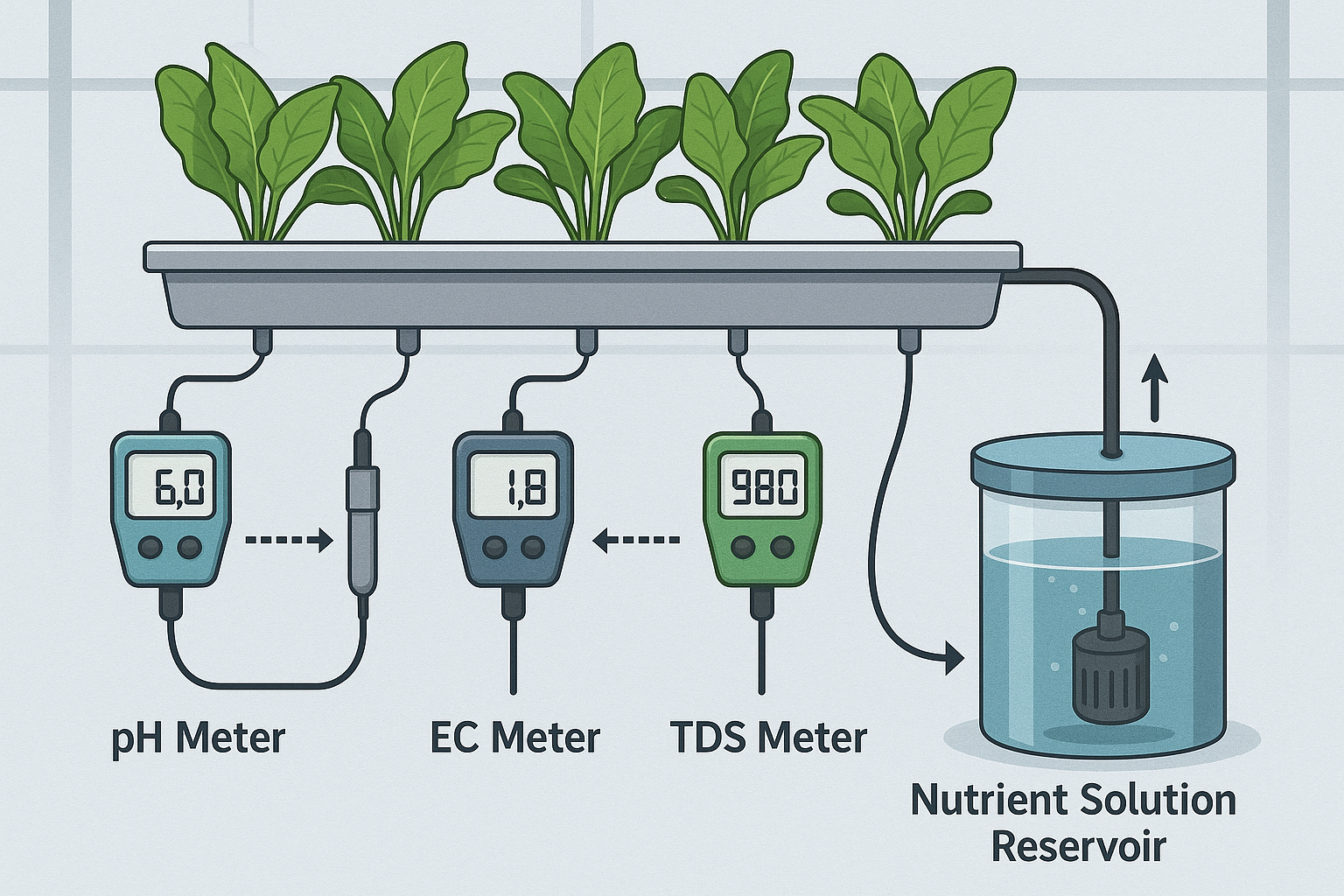
Electrical Conductivity: Your System’s Nutrition Dashboard
Electrical Conductivity (EC) measures the overall nutrient concentration in your solution, making it crucial for preventing both deficiencies and toxicities. Understanding EC readings and their implications allows growers to maintain optimal nutrition levels while avoiding the costly extremes of nutrient burn or deficiency.
EC works by measuring how well your nutrient solution conducts electricity. Pure water conducts electricity poorly, but dissolved salts and minerals increase conductivity proportionally to their concentration. This relationship allows EC meters to provide instant feedback on total nutrient concentration without identifying specific nutrients.
The EC measurement provides a real-time snapshot of your system’s nutritional status. Rising EC levels indicate increasing nutrient concentration from water loss through evaporation or plant transpiration. Falling EC levels suggest nutrient depletion through plant uptake or dilution from water additions.
Optimal EC levels vary by crop type, growth stage, and environmental conditions. Leafy greens typically thrive at EC levels between 1.2-1.8, while fruiting crops like tomatoes may require EC levels of 2.0-3.0 during peak production. Young plants generally require lower EC than mature plants, and hot weather may necessitate lower concentrations to prevent stress.
EC monitoring frequency should match your system’s dynamics and plant requirements. Fast-growing crops in warm conditions may require daily EC checks, while slower-growing plants in stable conditions might need monitoring only every few days. High-density systems with rapid water turnover require more frequent monitoring than larger systems with slower changes.
EC drift patterns provide valuable insights into system balance and plant health. Steady EC increases suggest adequate plant uptake with excessive water loss, while declining EC indicates strong nutrient uptake. Stable EC with good plant growth suggests optimal system balance, while erratic EC changes may indicate system problems requiring investigation.
Seasonal EC adjustments become necessary as plant requirements change with growth stage, weather conditions, and daylight hours. Spring plantings may start with lower EC that gradually increases as plants mature, while summer crops may require reduced EC during heat stress periods.
EC calibration and maintenance ensure accurate readings that support good decision-making. Monthly calibration with standard solutions maintains meter accuracy, while proper storage and cleaning protocols extend meter life and reliability.
Total Dissolved Solids: Understanding Water Purity
Total Dissolved Solids (TDS) measures water purity by indicating the concentration of dissolved contaminants and minerals. While closely related to EC, TDS provides specific information about solution composition that helps growers understand both nutrient levels and potential contamination issues.
TDS measurements represent the total weight of dissolved materials in your water, typically expressed in parts per million (ppm) or milligrams per liter. Unlike EC, which measures conductivity, TDS provides a direct measurement of dissolved solid concentration, making it easier to understand and compare across different solutions.
The relationship between EC and TDS follows predictable patterns, with most nutrient solutions showing EC-to-TDS conversion factors between 0.5-0.7. This means an EC reading of 2.0 typically corresponds to TDS levels of 1000-1400 ppm, depending on the specific nutrients and salts present.
Starting water TDS affects both nutrient calculation and system management. Water sources with high TDS may contain beneficial minerals but can also include harmful contaminants that interfere with plant nutrition. Understanding baseline water TDS helps growers adjust nutrient formulations and identify when water treatment becomes necessary.
Nutrient solution TDS provides clearer communication and record-keeping than EC measurements alone. Many fertilizer manufacturers provide TDS-based mixing instructions, and TDS readings are often easier for staff to understand and document consistently.
TDS monitoring helps identify system contamination that EC measurements might miss. Bacterial contamination, algae growth, or equipment corrosion can increase TDS without proportionally affecting conductivity, making TDS monitoring valuable for overall system health assessment.
Optimal TDS ranges vary by crop and growth stage, similar to EC guidelines. Most hydroponic crops perform best with TDS levels between 800-1500 ppm, with adjustments based on specific crop requirements, environmental conditions, and growth objectives.
TDS meter maintenance follows similar protocols to EC meters, requiring regular calibration and proper storage. Many modern meters measure both EC and TDS simultaneously, providing comprehensive solution analysis with a single instrument.
pH: The Gatekeeper of Nutrient Availability
pH affects nutrient absorption more than any other factor, with most plants thriving in the range of 5.5-6.5. Outside this range, plants cannot effectively uptake nutrients regardless of concentration, making pH management absolutely critical for hydroponic success.
pH represents the concentration of hydrogen ions in your solution, measured on a logarithmic scale from 0-14. Each pH unit represents a ten-fold change in acidity, making small pH changes more significant than they might appear. A pH change from 6.0 to 5.0 represents a ten-fold increase in acidity that can dramatically affect plant health.
Nutrient availability changes dramatically with pH level. Iron, manganese, and zinc become unavailable at high pH, while phosphorus availability decreases in both acidic and alkaline conditions. Incorrect pH leads to stunted growth and reduced yields even when nutrient concentrations are optimal.
Optimal pH ranges vary slightly among crops, but most hydroponic plants perform best between pH 5.5-6.5. Leafy greens often prefer slightly higher pH (6.0-6.5), while fruiting crops may perform better at slightly lower pH (5.5-6.0). Maintaining consistent pH within the optimal range maximizes nutrient uptake and plant performance.
pH drift occurs naturally as plants uptake nutrients and biological processes occur in the system. Young plants tend to increase solution pH as they uptake more anions than cations, while mature plants may decrease pH through increased cation uptake. Understanding these patterns helps growers anticipate and manage pH changes.
pH adjustment requires careful attention to both direction and magnitude of change. Large pH adjustments can shock plants and disrupt nutrient availability, making gradual adjustments preferable to dramatic corrections. Most systems benefit from daily pH monitoring and small adjustments rather than weekly large corrections.
pH adjustment products vary in their effects on solution chemistry and plant health. Phosphoric acid lowers pH while adding phosphorus, making it suitable for plants with high phosphorus requirements. Nitric acid provides nitrogen while lowering pH, benefiting plants during vegetative growth. Potassium hydroxide raises pH while adding potassium, supporting fruiting plants.
Buffer capacity affects how much your pH will change with nutrient uptake and biological processes. Solutions with high buffer capacity resist pH changes but require more adjustment chemicals when corrections are needed. Understanding your system’s buffer capacity helps plan adjustment strategies and monitoring frequency.
Automated pH control systems can maintain optimal pH with minimal labor input, though they require initial investment and ongoing maintenance. These systems use pH sensors and dosing pumps to automatically add adjustment chemicals when pH drifts outside set parameters.
The Great Debate: Full Changes vs. Top-Offs
One of the most debated topics in hydroponic management centers on whether to replace entire nutrient solutions regularly or simply top off existing solutions as water levels drop. Both approaches have merit, and the optimal choice often depends on system type, crop requirements, and operational constraints.
The Case for Full Nutrient Changes
Full nutrient solution changes every two weeks help prevent salt buildup and refresh the entire system. This approach provides completely fresh nutrients while removing accumulated salts, organic compounds, and potential contaminants that can build up over time.
Full changes eliminate guesswork about nutrient ratios and concentrations. After each change, growers know exactly what nutrients are available and in what concentrations, making it easier to troubleshoot problems and optimize plant nutrition. This predictability can be particularly valuable for inexperienced growers or complex systems.
Salt accumulation represents one of the strongest arguments for full changes. Even with careful monitoring, unused nutrients accumulate in the solution over time, potentially reaching concentrations that harm plant health. Full changes remove these accumulated salts while providing fresh, balanced nutrition.
Disease and contamination prevention benefits from fresh solution changes. Bacterial and fungal pathogens, algae spores, and organic compounds that can harbor pests are removed with old solutions, reducing disease pressure and improving system hygiene.
Simplified management appeals to many growers because full changes eliminate complex decisions about partial replacements and nutrient adjustments. Following a regular replacement schedule provides consistent results without requiring extensive expertise in solution chemistry.
Cost considerations for full changes include both nutrient replacement costs and disposal expenses. While the immediate cost appears higher than top-offs, full changes may reduce total costs by preventing problems that require expensive corrective treatments.
The Top-Off Approach: Efficiency and Conservation
Top-off methods reduce waste and costs by utilizing existing nutrients while maintaining appropriate water levels. This approach can significantly reduce input costs while providing environmental benefits through reduced water and nutrient consumption.
Resource conservation represents a major advantage of top-off systems. Top-offs maintain water levels while being more cost-effective than full changes, particularly in large systems where full changes require substantial nutrient quantities.
Flexible nutrient management becomes possible with top-off systems that allow growers to adjust individual nutrients as needed rather than replacing entire solutions. This precision can optimize plant nutrition while minimizing waste of unused nutrients.
Reduced environmental impact appeals to growers focused on sustainability. Top-off systems generate less nutrient-rich waste water while consuming fewer inputs, reducing both environmental impact and disposal costs.
Systematic top-off protocols require careful monitoring and adjustment to maintain optimal nutrition. Frequent monitoring becomes essential to maintain optimal conditions with top-off methods, but the investment in monitoring often pays dividends through improved plant performance and reduced input costs.
Hybrid Approaches: The Best of Both Worlds
Many successful growers combine elements of both approaches, using top-offs for routine management while scheduling full changes at strategic intervals. This hybrid approach can optimize both plant performance and resource efficiency.
Partial changes every 3-4 weeks provide some benefits of fresh nutrition while reducing waste compared to weekly full changes. Removing 50-75% of solution and replacing with fresh nutrients can refresh the system while retaining some existing nutrition.
Crop-specific schedules allow growers to match change frequency to plant requirements. Fast-growing crops may require more frequent changes, while slower crops can succeed with longer intervals between full changes.
Seasonal adjustments to change frequency can optimize systems for different growth periods. More frequent changes during rapid growth phases and less frequent changes during slower periods can balance plant needs with resource efficiency.
FarmHub logs EC, pH, and nutrient data from your sensors automatically. Set thresholds, get alerts, share the dashboard with your team. See how it works →
Developing Your Monitoring Schedule
Successful hydroponic operations depend on consistent, systematic monitoring that catches problems early while optimizing plant performance. Daily monitoring should include pH and EC checks, plant health inspections, and system maintenance.
Daily Monitoring Protocol
Daily checks form the foundation of effective hydroponic management. pH and EC readings should be taken at the same time each day to establish consistent baselines and detect trends early. Morning readings before plant activity peaks often provide the most stable measurements.
Visual plant inspections identify problems before they spread or become severe. Look for changes in leaf color, wilting, unusual growth patterns, or signs of pest or disease pressure. Early detection enables quick intervention that prevents minor problems from becoming major losses.
Water level monitoring ensures adequate solution volume while identifying unusual consumption patterns that might indicate leaks, excessive evaporation, or plant stress. Consistent water loss patterns help predict when top-offs or changes will be needed.
Equipment function checks verify that pumps, timers, and monitoring equipment are operating correctly. Brief inspections can identify failing equipment before it affects plant health or system performance.
Record keeping of daily measurements creates valuable data for trend analysis and problem diagnosis. Simple logs of pH, EC, water level, and observations provide information that becomes invaluable when troubleshooting problems or optimizing performance.
Weekly Management Tasks
Weekly activities should include system cleaning, nutrient adjustments, and component checks to maintain optimal system performance. These more intensive activities supplement daily monitoring with deeper system maintenance.
Nutrient solution analysis beyond basic pH and EC can identify specific nutrient deficiencies or excesses before they affect plant health. Testing individual nutrients or sending samples for laboratory analysis provides detailed information for optimization.
System cleaning removes algae, biofilm, and debris that can harbor pathogens or interfere with system function. Regular cleaning prevents problems while maintaining optimal water flow and equipment performance.
Equipment maintenance including pump cleaning, filter replacement, and calibration ensures reliable system operation. Preventive maintenance is far less expensive than emergency repairs or crop losses from equipment failure.
Nutrient adjustments based on plant growth stage, environmental conditions, or observed deficiencies optimize plant nutrition while preventing problems. Weekly adjustments allow fine-tuning that daily monitoring might miss.
Monthly Deep Maintenance
Monthly activities should include deep cleaning, replanting, and comprehensive system evaluation. These intensive tasks maintain long-term system health and performance.
Complete system cleaning removes accumulated organic matter, biofilms, and potential pathogen reservoirs that regular cleaning might miss. Deep cleaning provides opportunities to inspect system components and identify maintenance needs.
Nutrient solution replacement provides fresh nutrition while removing accumulated salts and organic compounds. Even systems using top-off methods benefit from periodic complete changes.
Equipment calibration and replacement ensures accurate monitoring and reliable system operation. Monthly calibration of pH and EC meters maintains measurement accuracy, while inspection of pumps and timers identifies components needing replacement.
System optimization based on accumulated data and observations allows growers to improve performance through equipment modifications, schedule adjustments, or management changes. Regular evaluation identifies opportunities for improvement that might not be apparent during daily operations.
Advanced Monitoring: Beyond the Basics
While pH, EC, and TDS provide fundamental information for system management, advanced monitoring can provide additional insights that optimize plant performance and prevent problems.
Individual Nutrient Analysis
Specific nutrient testing identifies imbalances that general EC measurements cannot detect. Nitrogen, phosphorus, and potassium levels can be monitored individually to ensure optimal ratios and prevent deficiencies or toxicities.
Secondary and micronutrient testing becomes important in systems running for extended periods with top-off management. Calcium, magnesium, iron, and other essential elements can become depleted or accumulate independently of EC changes.
Laboratory analysis provides the most accurate nutrient information but requires time and expense that may not be justified for routine monitoring. Monthly or quarterly lab tests can supplement daily measurements with detailed analysis for optimization.
Environmental Monitoring Integration
Temperature monitoring affects both nutrient uptake and solution management. Water temperature influences oxygen levels, nutrient solubility, and plant metabolism, making it an important parameter for overall system optimization.
Disssolved oxygen levels affect root health and nutrient uptake, particularly in deep water culture and NFT systems. Low oxygen can limit plant performance even when nutrition is optimal.
Light levels and cycles affect plant nutrient requirements and uptake patterns. Understanding the relationship between lighting and nutrition helps optimize both artificial and natural lighting systems.
Humidity and air circulation influence plant transpiration and water uptake, affecting solution concentration and nutrient requirements. Environmental monitoring helps optimize both plant growing conditions and nutrient management.
Technology Solutions: Making Monitoring Easier and More Accurate
Modern technology offers numerous solutions for improving monitoring accuracy, reducing labor requirements, and optimizing system performance through automated data collection and analysis.
Automated Monitoring Systems
Continuous monitoring systems provide real-time data on pH, EC, temperature, and other parameters without requiring daily manual measurements. These systems can alert growers to problems immediately while maintaining detailed records for analysis.
Data logging capabilities allow growers to track trends and patterns that might not be apparent from daily spot measurements. Historical data helps identify seasonal patterns, optimize management schedules, and troubleshoot recurring problems.
Alarm systems provide immediate notification when parameters exceed acceptable ranges, allowing quick intervention to prevent plant damage. Mobile alerts enable growers to respond to problems even when not physically present at the operation.
Integration with control systems allows automatic adjustment of pH, nutrient concentration, and other parameters based on sensor feedback. These systems can maintain optimal conditions with minimal human intervention while providing detailed records of all adjustments.
Portable and Laboratory Testing
Handheld meters provide accurate, convenient testing for multiple parameters in single instruments. Modern meters can measure pH, EC, TDS, temperature, and dissolved oxygen in one device, simplifying monitoring while improving accuracy.
Test strips and kits offer backup testing capabilities and specific nutrient analysis at lower cost than electronic meters. While less precise than electronic instruments, chemical tests can provide valuable information and verification of meter readings.
Laboratory services provide the most accurate and detailed nutrient analysis available, though at higher cost and with longer turnaround times. Laboratory testing can identify specific deficiencies and optimize nutrient formulations for maximum efficiency.

Economic Impact: The True Cost of Poor Monitoring
Understanding the financial implications of monitoring decisions helps justify investments in equipment and protocols while avoiding costly mistakes that can devastate profitability.
Direct Costs of Poor Monitoring
Yield losses from nutrient imbalances can reduce harvest weight and quality by 20-50%, directly impacting revenue from affected crops. Poor monitoring allows problems to develop and spread before correction, maximizing damage and losses.
Input waste from incorrect nutrient levels, unnecessary solution changes, or emergency corrections increases operating costs while reducing profitability. Proper monitoring prevents waste while optimizing input efficiency.
Crop replacement costs become necessary when monitoring failures lead to plant death or unmarketable quality. Replacement crops require additional inputs and delay harvest schedules, compounding losses from the original problem.
Hidden Costs and Opportunity Costs
Reduced plant quality affects marketability and pricing even when crops survive nutrient problems. Poor monitoring that allows suboptimal conditions reduces crop value while increasing susceptibility to post-harvest problems.
Increased susceptibility to pests and diseases results from plant stress caused by nutrient imbalances. Stressed plants require additional treatments while producing lower yields and quality.
Lost market opportunities occur when poor monitoring delays harvests or reduces quality below market standards. Missing contracted deliveries or peak pricing windows reduces revenue and damages customer relationships.
Return on Investment from Monitoring
Proper monitoring equipment and protocols typically pay for themselves within one growing season through improved yields, reduced waste, and prevented losses. The investment in monitoring represents insurance against far more expensive problems.
Optimized nutrition from good monitoring can increase yields by 20-40% while reducing input costs through improved efficiency. These improvements compound over time, providing ongoing returns on monitoring investments.
Improved consistency from systematic monitoring reduces variability in yields and quality, making operations more predictable and profitable. Consistent production enables better planning and market relationships.
Moving Forward: Implementing Effective Monitoring
Successful implementation of monitoring protocols requires planning, investment, and commitment to consistent execution. The most sophisticated monitoring equipment provides no benefit without proper use and follow-through.
Start with basic pH and EC monitoring if you’re not already measuring these parameters consistently. Reliable measurement of these fundamental parameters provides the foundation for all other monitoring activities.
Develop consistent routines for testing, recording, and responding to measurements. Consistency in timing, methods, and record-keeping ensures comparable data and reliable trend identification.
Invest in quality equipment appropriate for your operation size and complexity. While expensive meters aren’t necessary for every operation, accurate, reliable instruments are essential for good decision-making.
Train all staff involved in monitoring to ensure consistent technique and interpretation. Everyone involved should understand what they’re measuring, why it matters, and how to respond to different readings.
Use monitoring data to continuously improve your operation through trend analysis, optimization experiments, and systematic problem-solving. Monitoring is only valuable when the information is used to make better management decisions.
Your nutrient data should work harder than you do. FarmHub connects your sensors to one dashboard, tracks trends over time, and alerts your team when something drifts. Start free →
The difference between successful and struggling hydroponic operations often comes down to the quality and consistency of their monitoring programs. While the plants provide the final measure of success, the nutrient solution holds the key to achieving that success consistently and profitably. Master your monitoring, and you’ll master your system.