
The phone call came at 3 AM. Sarah’s aquaponics system had crashed overnight—fish gasping at the surface, plants wilting, and thousands of dollars of investment hanging in the balance. Six months later, her farm is thriving, but the journey taught her what no sales brochure mentioned: success in controlled environment agriculture isn’t just about the technology you buy, it’s about understanding the intricate dance between biology, economics, and operational discipline.
For small commercial growers, aquaponics and vertical farming represent both unprecedented opportunity and formidable challenge. The global vertical farming market is projected to explode from $4.1 billion in 2021 to over $21 billion by 2030, driven by a compound annual growth rate of 24.2%. Yet behind these impressive numbers lies a more complex reality: these systems demand technical precision, significant capital, and operational expertise that can make or break a farming business.
The Cold-Water Aquaponics Revolution
Traditional aquaponics wisdom centered around warm-water fish like tilapia, but recent innovations have opened doors for cold-water species that can thrive in regions previously considered unsuitable for year-round production. This shift matters because it expands the geographic and seasonal viability of aquaponics systems, particularly for growers in temperate climates who previously faced seasonal shutdowns.
The key breakthrough lies in optimized biofiltration and enhanced microbial communities that improve nutrient cycling and water quality management. Cold-water systems require different bacterial populations and cycling times, but when properly established, they can maintain stable conditions with less energy input than heated systems. The trick is understanding that cold-water aquaponics isn’t simply warm-water aquaponics at lower temperatures—it’s a fundamentally different biological system.
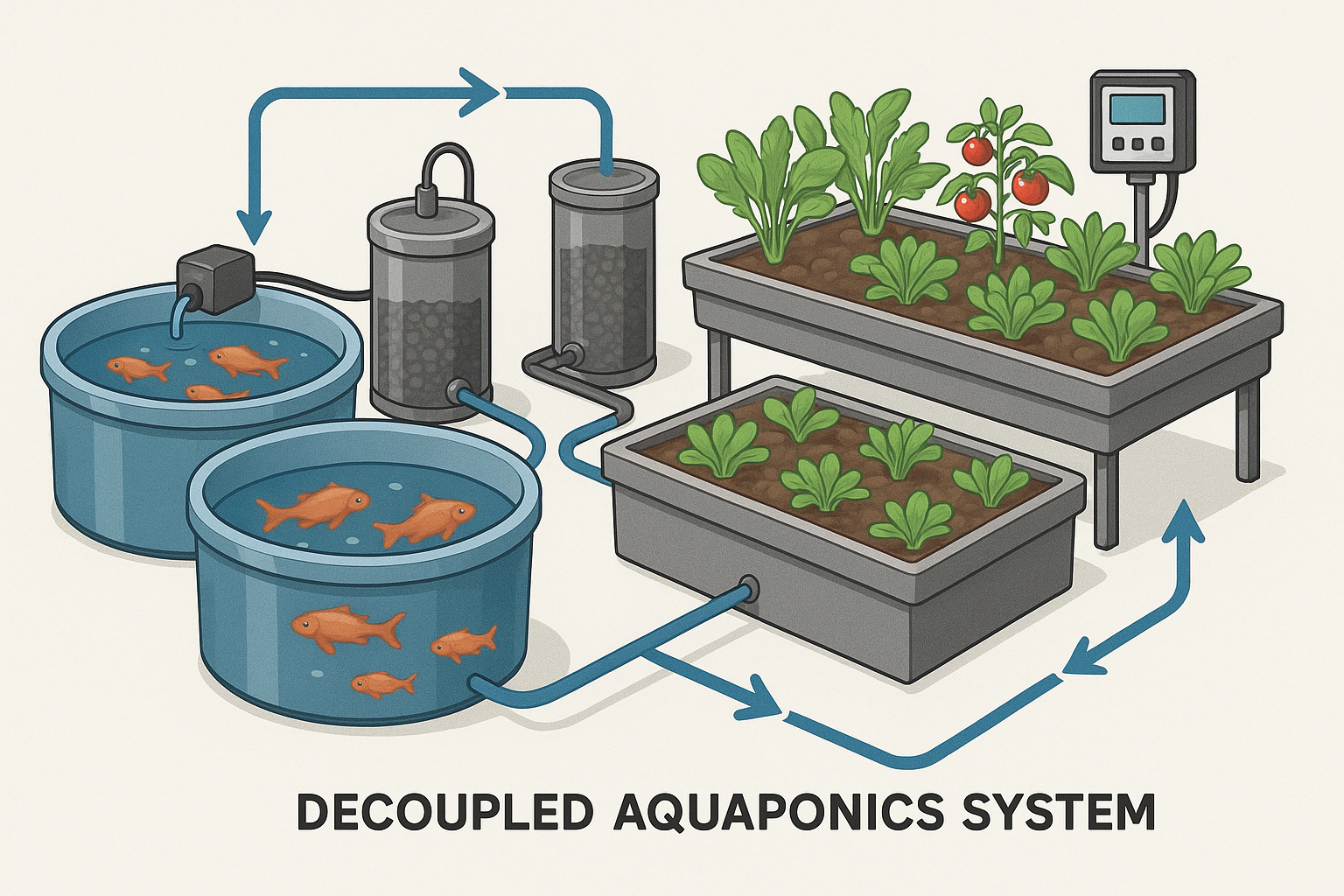
Decoupled aquaponics systems have emerged as a game-changer for small commercial operations. Unlike traditional coupled systems where fish and plants share the same water loop, decoupled designs allow independent management of each component. Fish tanks can be optimized for growth and health while plant beds receive precisely balanced nutrients. This separation prevents the compromise scenarios that plague many aquaponics operations, where plants suffer from suboptimal nutrient ratios or fish stress from plant-focused water chemistry.
The practical benefits are substantial. Decoupled systems allow growers to adjust plant nutrition independently, addressing common problems like calcium deficiency that frequently stunts growth in coupled systems. They also provide operational flexibility—if one component fails, the other can continue functioning, preventing total system loss.
Managing the Invisible: Water Quality and Flow Dynamics
Every successful aquaponics operator learns the same hard lesson: what you can’t see will hurt you first. Water quality management extends far beyond basic pH and dissolved oxygen monitoring. Smart monitoring systems integrated with IoT sensors now provide real-time tracking of multiple parameters, but the real value lies in understanding how these parameters interact.
Clogged pipes and uneven water flow represent some of the most common operational failures in aquaponics systems. These aren’t just maintenance nuisances—they’re system killers that can cascade into fish mortality and crop loss within hours. Practical solutions for flow management include strategically placed bypass valves, redundant pump systems, and particle separators that prevent organic matter from accumulating in critical flow paths.
The nutrient balance equation in aquaponics is more complex than most growers initially realize. Fish waste provides nitrogen, but plants need phosphorus, potassium, and micronutrients that fish waste doesn’t supply in adequate quantities. Calcium deficiency particularly affects plant health, manifesting as stunted growth, blossom end rot in fruiting crops, and reduced yields. Successful operators supplement strategically, adding calcium hydroxide or chelated nutrients to maintain plant health without disrupting fish welfare.
The Vertical Hydroponics Opportunity
While aquaponics captures attention for its integrated approach, vertical hydroponics offers a different value proposition: maximum production per square foot with minimal biological complexity. Space-efficient vertical systems can maximize crop yield in urban settings where land costs make horizontal growing uneconomical.
The technology has matured rapidly. Modern vertical systems integrate renewable energy sources to reduce operational costs, addressing one of the primary economic challenges facing the industry. LED lighting efficiency improvements and solar integration have reduced energy costs per pound of production by 30-40% over the past five years.
Vertical hydroponics offers compelling environmental benefits: reduced land use, water conservation through recirculation, and minimized pesticide dependence through controlled environment protection. For small commercial growers, these benefits translate into consistent production quality, predictable yields, and reduced crop insurance costs.

The Automation Advantage
Precision agriculture technologies have evolved beyond simple monitoring to active system management. AI-driven automation systems can reduce water and fertilizer use by 30-40% while improving crop consistency and reducing labor requirements. For small operations where labor costs can consume 40-60% of revenue, automation-driven labor efficiency improvements of 20-40% represent the difference between profit and loss.
The key insight is that automation works best when it augments human decision-making rather than replacing it entirely. Successful systems alert operators to developing problems while providing data-driven recommendations for intervention. They handle routine tasks like nutrient dosing and environmental adjustments while leaving strategic decisions about crop selection, harvest timing, and system modifications to human judgment.
The Economic Reality Check
The growth projections and technological capabilities paint an optimistic picture, but high initial capital costs, energy consumption, and operational expenses remain significant barriers. Small commercial growers face a fundamental challenge: controlled environment systems require substantial upfront investment with payback periods that can extend 3-7 years depending on crop selection and market conditions.
High energy consumption from lighting and climate control represents an ongoing operational burden. Even with LED efficiency improvements, energy costs typically account for 25-30% of operating expenses in vertical systems. Heating, cooling, and ventilation add another 15-20%, making energy management a critical success factor.
The investment calculation extends beyond equipment costs to include facility preparation, permitting, insurance, and working capital for the first growing cycles. A 2,000-square-foot vertical growing facility can require $150,000-$300,000 in initial investment, while a commercial aquaponics system of similar production capacity ranges from $100,000-$250,000.
Emerging Alternatives and Hybrid Approaches
Innovative growers are exploring hybrid systems that combine the best aspects of different approaches. Vermi-aquaponics incorporates worms for enhanced organic matter breakdown, improving nutrient cycling and reducing maintenance requirements. Flocponics utilizes microbial flocs for improved nutrient capture, creating more efficient systems with reduced water exchange requirements.
Novel substrates like sandponics and algaeponics offer alternative pathways for nutrient retention and cycling. These approaches reduce complexity while maintaining many of the sustainability benefits of traditional aquaponics. The trade-off is typically lower integration between system components, but improved operational predictability.
Strategic Planning for System Integration
Successful adoption requires viewing controlled environment agriculture as a business system rather than a farming technique. Market analysis becomes crucial—understanding local demand, pricing dynamics, and distribution channels before committing to specific crops or production methods.
Crop selection drives system design decisions. High-value leafy greens and herbs offer faster turnover and higher profit margins but require consistent quality and reliable supply chains. Fruiting crops like tomatoes and peppers provide higher revenue per plant but longer growing cycles and increased technical complexity.
Scaling decisions matter enormously. Systems that work well at 500 square feet can fail when expanded to 2,000 square feet due to increased complexity, labor requirements, and quality control challenges. Successful growers often phase expansion, mastering smaller systems before investing in larger operations.
The Path Forward
The convergence of technological capability, market demand, and environmental pressure creates genuine opportunity for small commercial growers willing to embrace controlled environment agriculture. The 24.2% compound annual growth rate in vertical farming reflects real market expansion driven by consumer demand for local, sustainable produce and the economic pressures facing traditional agriculture.
Success requires honest assessment of technical capability, financial resources, and market positioning. Growers who thrive in controlled environments typically combine technical precision with business discipline, treating system management as both an agricultural and operational challenge.
The technology exists to make these systems profitable. The market demand continues expanding. The question for small commercial growers isn’t whether controlled environment agriculture represents the future—it’s whether they can position themselves to participate successfully in that future.
For those willing to invest in learning, planning, and systematic implementation, aquaponics and vertical farming offer genuine pathways to sustainable, profitable production. The key lies in understanding that success comes not from the technology itself, but from the knowledge, discipline, and strategic thinking that turns innovative systems into thriving businesses.