
Your fish are gasping at the surface. Your plants are wilting despite adequate water. Your once-thriving aquaponics system is collapsing, and you can’t figure out why. The culprit might be invisible to the naked eye, but its effects are devastating: inadequate dissolved oxygen levels that are slowly suffocating your entire system.
Oxygen management in aquaponics isn’t just about keeping fish alive—it’s about maintaining the complex biological processes that make the entire system function. Fish, plants, and beneficial bacteria all compete for the same dissolved oxygen, and when supply can’t meet demand, the results are swift and catastrophic. What makes this particularly insidious is that oxygen problems often develop gradually, with subtle warning signs that many growers miss until it’s too late.
For small commercial farmers, poor oxygen management represents one of the fastest ways to lose an entire season’s investment. Fish die, plants fail, and the beneficial bacteria that drive nutrient cycling collapse. But the opposite is also true: proper oxygen management can dramatically improve yields, reduce disease pressure, and create systems that are more resilient and profitable.
The difference between struggling with oxygen issues and mastering them lies in understanding the interconnected relationships between fish density, plant load, bacterial activity, and environmental factors. It’s not enough to simply add more air stones—you need to understand what’s actually consuming oxygen in your system and how to balance supply with demand.
Most aquaponics guides treat oxygen as a simple parameter to monitor, but successful commercial growers understand that oxygen management is actually a complex system that requires understanding biology, chemistry, physics, and economics. Master oxygen management, and you’ll have solved one of the most critical challenges in aquaponics production.
Understanding the Oxygen Economy: Who’s Using What
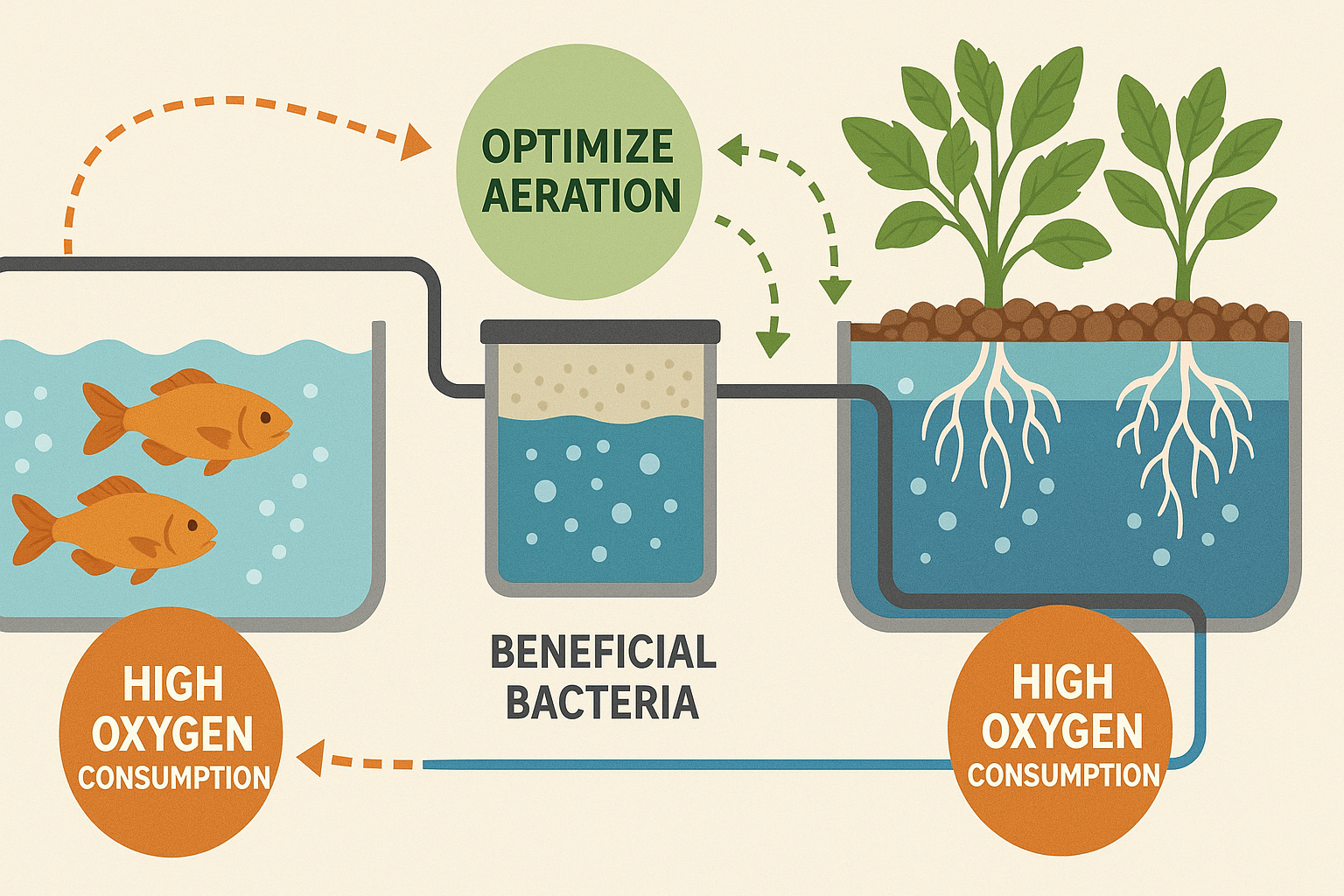
Think of your aquaponics system as having an oxygen economy where different biological processes are constantly competing for a limited supply. Understanding who the major consumers are helps you make informed decisions about system design and management.
Fish: The Obvious Consumers
Fish are the most visible oxygen consumers in aquaponics systems, but their actual consumption patterns are more complex than many growers realize. Fish require dissolved oxygen levels of 5–7 ppm for optimal health, but this requirement varies dramatically based on species, size, temperature, and activity level.
Water temperature affects fish oxygen consumption exponentially, not linearly. As water temperature increases, fish metabolism accelerates, requiring more oxygen just as the water’s capacity to hold oxygen decreases. This creates a double burden that can quickly overwhelm systems during hot weather. A 10°F temperature increase can double fish oxygen consumption while reducing oxygen solubility by 10-15%.
Fish size and biomass create oxygen demands that many growers underestimate. Large fish consume disproportionately more oxygen than small fish, and total system biomass determines baseline oxygen consumption. A 100-gallon system supporting 20 pounds of fish will have very different oxygen requirements than the same system supporting 50 pounds of fish.
Feeding activity creates temporary spikes in oxygen consumption as fish digest food and excrete waste. The post-feeding period—typically 2-4 hours after feeding—represents peak oxygen demand when fish are most active and metabolizing food. Many oxygen-related fish kills occur during this critical period when systems are already stressed.
Species-specific requirements vary dramatically even among commonly used aquaponics fish. Trout require higher oxygen levels than tilapia, while catfish can tolerate lower levels than either. Understanding your specific fish species’ requirements helps set appropriate oxygen targets for system management.
Beneficial Bacteria: The Hidden Oxygen Hogs
Beneficial bacteria often consume more oxygen than fish, but their consumption is invisible and constantly changing as they process waste and convert ammonia to nitrate. These bacteria are aerobic, meaning they require oxygen to function, and their activity directly affects both water quality and oxygen availability.
Nitrifying bacteria populations fluctuate based on waste loading, temperature, and system maturity. New systems with establishing bacterial populations may have lower oxygen consumption initially, but as bacteria colonies mature and waste processing becomes more efficient, oxygen consumption can increase dramatically.
The biofilm locations where bacteria concentrate—biofilter media, plant roots, and tank surfaces—create localized areas of high oxygen consumption. These areas can become oxygen-depleted even when the main water body appears to have adequate oxygen levels.
Waste processing efficiency affects oxygen consumption patterns. Systems with high waste loads require more bacterial activity to process waste, consuming more oxygen in the process. Overfeeding or high fish densities can create bacterial oxygen demands that exceed system capacity.
Plant Roots: The Night Shift
Plant roots consume oxygen continuously, but their consumption patterns differ dramatically from fish and bacteria. Plants require dissolved oxygen levels of 4–12 mg/L for optimal root function, with consumption varying based on plant species, root mass, and environmental conditions.
Nighttime oxygen consumption by plants often surprises new growers. While plants produce oxygen during photosynthesis, they consume oxygen continuously for root respiration. Large plant systems can create significant nighttime oxygen demand just when natural oxygen production is lowest.
Root zone oxygen depletion can occur even when main water bodies have adequate oxygen levels. Dense root systems in grow beds create high local oxygen demand that can exceed local supply, leading to root rot and plant stress despite apparently adequate system-wide oxygen levels.
Plant species vary significantly in their oxygen requirements. Leafy greens typically require less oxygen than fruiting plants, while plants with extensive root systems consume more oxygen than those with compact root systems. Crop selection affects total system oxygen demand.
Algae: The Oxygen Swingers
Algae can cause dramatic oxygen swings that stress fish and plants. During daylight hours, algae produce oxygen through photosynthesis, potentially creating supersaturated conditions. At night, algae consume oxygen for respiration, sometimes creating dangerous oxygen depletion.
Algae blooms can quickly overwhelm system oxygen balance. Rapid algae growth consumes nutrients and produces oxygen during the day, but when algae populations crash or during extended dark periods, oxygen consumption can exceed production, creating life-threatening conditions for fish.
The timing of algae-related oxygen problems often occurs at night or during cloudy periods when photosynthesis decreases but respiration continues. These conditions can create rapid oxygen depletion that kills fish before growers realize there’s a problem.
Bio-Load Management: Balancing the Equation
Successful oxygen management requires understanding and controlling the biological load in your system. Bio-load encompasses all the living organisms that consume oxygen, and managing this load is crucial for maintaining adequate oxygen levels.
Fish Density Guidelines
Fish density recommendations vary significantly based on species, system design, and aeration capacity, but general guidelines suggest 10–40 kg of fish per 1,000 liters of water. These guidelines must be adjusted based on your specific system’s oxygen production capacity.
Stocking density calculations should account for adult fish size, not juvenile size. Many growers stock systems based on fingerling fish, not realizing that as fish grow, their oxygen consumption increases exponentially. A system that supports 100 small fish may not support 100 large fish without additional aeration.
Species-specific stocking rates require understanding each species’ oxygen requirements and tolerance levels. Trout systems typically require lower stocking densities than tilapia systems due to higher oxygen requirements, while catfish can tolerate higher densities than either species.
Growth rate planning affects bio-load management because rapidly growing fish increase their oxygen consumption over time. Systems that are properly loaded initially may become overloaded as fish grow, requiring either harvesting or additional aeration to maintain adequate oxygen levels.
Seasonal adjustments to fish density may be necessary as temperature and biological activity change throughout the year. Summer periods with higher temperatures and increased biological activity may require reduced fish densities to prevent oxygen depletion.
Feed Management and Oxygen Impact
Feeding practices directly affect oxygen consumption through multiple pathways. Overfeeding increases fish oxygen consumption, creates more waste that requires bacterial processing, and can lead to algae blooms that create oxygen swings.
Feed quality affects oxygen consumption patterns. High-quality feeds that are efficiently digested create less waste and require less bacterial processing, reducing total system oxygen demand. Poor-quality feeds that are poorly digested increase waste loading and bacterial oxygen consumption.
Feeding timing can help manage oxygen consumption by avoiding peak demand periods. Feeding during periods of high oxygen production—typically midday—allows systems to better accommodate increased oxygen consumption from digestion.
Uneaten feed creates additional oxygen demand as it decomposes, often exceeding the oxygen cost of the feed itself. Proper feeding practices that minimize uneaten feed help control biological load and oxygen consumption.
Waste Management and Oxygen
Waste accumulation creates ongoing oxygen demand as bacteria process organic matter. Solid waste removal reduces bacterial oxygen consumption while improving overall system efficiency.
Filtration systems that remove solid waste before it begins decomposing can significantly reduce system oxygen demand. Mechanical filtration, settling tanks, and regular cleaning help control waste loading and associated oxygen consumption.
Composting or vermi-composting systems can process solid waste outside the main aquaponics system, reducing internal oxygen demand while creating valuable soil amendments. These approaches remove oxygen-consuming processes from the main system.
Warning Signs: Recognizing Oxygen Problems Before They Become Catastrophic
Early detection of oxygen problems can prevent catastrophic losses, but many warning signs are subtle and easily missed. Understanding these indicators helps implement corrective measures before fish kills or plant failures occur.
Fish Behavior Indicators
Fish behavior changes often provide the earliest warning signs of oxygen problems. Fish exhibiting surface gasping, lethargic swimming, or clustering near areas of water agitation indicate developing oxygen stress before measurable changes in dissolved oxygen levels.
Surface gasping represents an attempt to access oxygen-rich water at the surface where gas exchange occurs. Fish that normally swim throughout the water column but begin spending time at the surface may be indicating oxygen depletion in deeper water.
Erratic swimming patterns, including rapid swimming followed by periods of inactivity, can indicate oxygen stress. Fish experiencing oxygen stress often exhibit burst swimming as they search for oxygen-rich water, followed by periods of reduced activity to conserve oxygen.
Reduced feeding activity often accompanies oxygen stress as fish prioritize oxygen conservation over feeding. Fish that normally feed aggressively but suddenly lose interest in food may be experiencing oxygen limitations.
Nighttime fish kills without obvious cause often result from oxygen depletion during periods of peak consumption and minimal production. Finding dead fish in the morning after they appeared healthy the evening before strongly suggests oxygen problems.
Plant Stress Indicators
Plant symptoms of oxygen stress can be subtle and are often attributed to other causes. Root rot, wilting despite adequate water, and poor growth rates can all indicate oxygen stress in the root zone.
Wilting plants in constantly wet conditions often indicate root zone oxygen depletion. When plant roots can’t access oxygen, they lose the ability to uptake water and nutrients, leading to wilting symptoms despite adequate water availability.
Yellowing or browning of lower leaves can indicate root stress from oxygen depletion. Roots that can’t access oxygen begin to die, reducing the plant’s ability to uptake nutrients and leading to nutrient deficiency symptoms.
Poor fruit set or flower drop in fruiting plants often results from root stress caused by oxygen depletion. Stressed root systems can’t support the energy requirements of fruit and flower development.
Slow growth rates despite adequate nutrition can indicate root zone oxygen limitations. Plants with oxygen-stressed roots grow slowly even when water chemistry appears optimal.
Water Quality Indicators
Water quality changes often accompany oxygen problems and can provide early warning signs before biological symptoms appear. pH fluctuations, increased turbidity, and unusual odors can all indicate developing oxygen issues.
PH fluctuations often accompany oxygen problems as biological processes change. Increased bacterial activity from waste processing can lower pH, while algae blooms can cause pH swings.
Foul odors, particularly sulfur or rotten egg smells, indicate anaerobic conditions where oxygen-depleted areas allow harmful bacteria to proliferate. These odors often develop before fish or plant symptoms become apparent.
Increased turbidity from bacterial blooms can indicate system imbalance that affects oxygen levels. Cloudy water often accompanies conditions that increase oxygen consumption.
FarmHub tracks dissolved oxygen levels across your system and alerts your team when readings drift. Connect your sensors →
Affordable Aeration Solutions: Getting More Bang for Your Buck
Effective aeration doesn’t require expensive equipment, but it does require understanding how different aeration methods work and when to use each approach. The key is matching aeration methods to your specific system needs and constraints.
Air Stones and Diffusers: The Foundation
Air stones and diffusers provide the most cost-effective aeration for most aquaponics systems. Air pumps and stones create fine bubbles that maximize oxygen transfer efficiency. The key to effective air stone aeration is proper sizing, placement, and maintenance.
Air stone sizing should be based on system volume and biological load rather than tank size alone. A 100-gallon tank with 50 pounds of fish requires more aeration than a 100-gallon tank with 20 pounds of fish. Calculate aeration needs based on total oxygen consumption, not just water volume.
Air stone placement affects efficiency significantly. Stones placed at the bottom of tanks maximize contact time between air bubbles and water, improving oxygen transfer. Multiple smaller stones often work better than single large stones because they create more total surface area for gas exchange.
Fine bubble diffusers typically provide better oxygen transfer than coarse bubble stones because smaller bubbles have more surface area per unit volume. However, fine bubble diffusers require more maintenance and may clog more easily than coarse bubble stones.
Redundant air stone systems provide insurance against equipment failure. Installing multiple air stones powered by separate air pumps ensures that pump failure doesn’t create catastrophic oxygen depletion.
Surface Agitation: Natural and Effective
Surface agitation through waterfalls, sprayers, or pumps enhances natural oxygen exchange by increasing the water surface area exposed to air. This approach works particularly well in systems with adequate surface area for gas exchange.
Waterfall systems create excellent surface agitation while providing visual and auditory appeal. The falling water creates turbulence that breaks the surface tension and allows efficient gas exchange. Waterfall height and flow rate affect oxygen transfer efficiency.
Spray systems can provide effective surface agitation in larger systems where waterfalls aren’t practical. Multiple small sprays often work better than single large sprays because they create more total surface disturbance.
Venturi systems use water flow to draw air into the system, creating both surface agitation and direct air injection. These systems can be particularly effective in high-flow systems where water circulation provides the energy for aeration.
Return pipe design affects surface agitation efficiency. Pipes designed to splash water back into tanks create surface agitation that enhances oxygen transfer without requiring additional energy input.
Pump System Optimization
Water circulation pumps can provide significant aeration benefits when properly designed and operated. High-flow systems naturally create more water movement and surface agitation, improving oxygen transfer throughout the system.
Pump placement affects both circulation and aeration efficiency. Pumps that create strong water movement help prevent dead zones where oxygen can become depleted, while pumps that create surface agitation directly contribute to oxygen transfer.
Multiple smaller pumps often provide better aeration than single large pumps because they create more circulation points and provide redundancy against pump failure. Distributed pumping systems can maintain circulation even if one pump fails.
Timer-controlled pumps can provide intermittent high-flow operation that creates periodic surface agitation and circulation bursts. This approach can be particularly effective during periods of high oxygen demand.
DIY Aeration Solutions
Homemade aeration systems can provide effective oxygen transfer at very low cost. PVC pipe manifolds with small holes can create distributed air distribution systems. Aquarium air pumps can power multiple air stones through simple valve systems.
Gravity-fed aeration systems use siphon principles to create air suction without requiring electric pumps. These systems work well as backup aeration or in locations where electrical power isn’t available.
Wind-powered aeration systems can provide continuous low-level aeration in windy locations. Simple windmill designs can power air pumps or surface agitation systems without requiring electrical input.
Solar-powered air pumps provide renewable energy aeration for remote locations or as backup systems. Small solar panels can power air pumps during daylight hours when oxygen production is typically highest.

Degassing: The Often Overlooked Solution
Degassing—the removal of dissolved gases from water—often provides more benefit than simple oxygen addition. Many aquaponics systems suffer from excess carbon dioxide that inhibits oxygen uptake and stresses fish, making CO2 removal as important as oxygen addition.
Understanding Gas Exchange
Water naturally dissolves gases from the air it contacts, but it can also become supersaturated with gases produced by biological processes. CO2 from fish respiration and bacterial activity can build up to levels that stress fish and inhibit their ability to uptake oxygen.
Gas exchange occurs at the water surface where dissolved gases escape to the atmosphere and atmospheric gases dissolve into water. Increasing surface area and agitation enhances this natural process, helping remove excess CO2 while adding oxygen.
Temperature affects gas solubility, with warmer water holding less dissolved gas than cooler water. Sudden temperature changes can cause gas supersaturation or depletion, creating conditions that stress fish and plants.
Barometric pressure also affects gas solubility, with lower pressure allowing more gas to escape from solution. Weather changes can affect dissolved gas levels, particularly in sealed systems with limited gas exchange.
Degassing Techniques
Aeration systems that create vigorous water movement provide effective degassing by bringing supersaturated water into contact with air. The same systems that add oxygen also remove excess CO2 and other dissolved gases.
Cascading water systems create excellent degassing by repeatedly exposing water to air as it flows through the system. Multi-level systems with waterfalls or cascades naturally provide degassing benefits.
Ventilation systems that ensure adequate air exchange help prevent gas buildup in enclosed systems like greenhouses. Stagnant air can become enriched with CO2 from plant respiration, reducing the effectiveness of surface gas exchange.
Spray systems that create fine water droplets maximize surface area for gas exchange, providing effective degassing while adding oxygen. Misting systems work particularly well for degassing applications.
Monitoring and Maintenance: Staying Ahead of Problems
Effective oxygen management requires consistent monitoring and proactive maintenance. Understanding when and how to test dissolved oxygen levels helps prevent problems before they become critical.
Testing Equipment and Procedures
Digital dissolved oxygen meters provide the most accurate and convenient method for monitoring oxygen levels. These meters require regular calibration and proper maintenance but provide real-time data essential for oxygen management.
Test kits using chemical indicators provide backup testing capability and help verify digital meter readings. These kits are less convenient than digital meters but can provide accurate results when properly used.
Testing frequency should increase during periods of high biological activity, temperature changes, or system modifications. Daily testing becomes necessary during hot weather, high feeding periods, or when introducing new fish.
Testing locations should include different areas of the system to identify potential dead zones or areas of poor circulation. Test near the bottom of fish tanks, in grow beds, and in areas with poor water movement.
Record keeping helps identify patterns and trends in dissolved oxygen levels. Tracking oxygen levels alongside temperature, feeding rates, and biological activity helps understand system dynamics and predict problems.
Preventive Maintenance
Regular cleaning and maintenance of aeration equipment prevents gradual degradation of oxygen transfer efficiency. Clean air stones, check air pump filters, and verify proper operation of all aeration equipment.
Seasonal maintenance should include comprehensive system checks before periods of high oxygen demand. Verify adequate aeration capacity, clean equipment, and test backup systems before hot weather or high feeding periods.
Equipment redundancy provides insurance against aeration system failure. Install backup air pumps, extra air stones, and alternative aeration methods to prevent catastrophic oxygen depletion during equipment failure.
Water quality maintenance helps prevent conditions that increase oxygen consumption. Regular cleaning, proper feeding practices, and waste management reduce biological load and oxygen demand.
Emergency Procedures
Oxygen emergency protocols should be written, practiced, and immediately available. Know how to quickly increase aeration, reduce biological load, and provide emergency oxygen if needed.
Emergency aeration equipment should be readily available and tested regularly. Battery-powered air pumps, portable generators, and emergency oxygen sources can prevent fish kills during power outages or equipment failures.
Fish rescue procedures may become necessary during severe oxygen depletion. Have aerated emergency tanks ready and know how to quickly move fish to safer conditions.
System recovery after oxygen emergencies requires careful monitoring and gradual return to normal operations. Stressed fish are more susceptible to disease and may require modified feeding and management procedures.
Advanced Oxygen Management: Beyond the Basics
Once you’ve mastered basic oxygen management, advanced techniques can provide even better system performance and reliability. These approaches require more sophisticated understanding but can provide significant benefits for commercial operations.
Oxygen Injection Systems
Pure oxygen injection systems can provide precise oxygen control in high-density systems. These systems use pressurized oxygen to achieve dissolved oxygen levels that exceed air saturation, supporting higher fish densities and more intensive production.
Venturi oxygen injectors can be retrofitted to existing circulation systems to provide supplemental oxygen. These devices use water flow to draw oxygen from pressurized sources, providing supplemental oxygen without requiring additional pumping.
Oxygen concentrators provide a continuous supply of concentrated oxygen for injection systems. These devices extract oxygen from air, providing a more economical oxygen source than pressurized bottles for continuous operation.
Automated Control Systems
Automated oxygen control systems use dissolved oxygen sensors to automatically adjust aeration based on real-time measurements. These systems can maintain optimal oxygen levels while minimizing energy consumption.
Solenoid-controlled air valves can provide precise aeration control based on dissolved oxygen readings. These systems can automatically increase aeration during periods of high demand and reduce it during periods of low demand.
Alarm systems provide immediate notification of oxygen problems, allowing quick response to prevent fish kills. These systems can send alerts via phone, email, or text message when oxygen levels drop below safe thresholds.
Data logging systems track dissolved oxygen levels over time, providing valuable information for system optimization and troubleshooting. Historical data helps identify patterns and optimize aeration strategies.
System Design Optimization
Water flow design that eliminates dead zones and promotes uniform circulation helps prevent localized oxygen depletion. Proper hydraulic design ensures that all areas of the system receive adequate water movement and oxygen exchange.
Biofilter design affects both oxygen consumption and production. Efficient biofilters that provide adequate surface area for bacterial growth while maintaining good water circulation help optimize oxygen balance.
Tank design features like sloped bottoms and strategically placed drains help prevent waste accumulation that increases oxygen demand. Proper tank design reduces maintenance requirements while improving oxygen management.
Aeration system design should account for system hydraulics, biological load, and environmental conditions. Comprehensive aeration design considers all factors that affect oxygen supply and demand.
Mastering oxygen management in aquaponics requires understanding the complex interactions between biological processes, system design, and environmental factors. It’s not enough to simply add more air stones—you need to understand what’s consuming oxygen in your system and how to balance supply with demand efficiently.
Your sensors are collecting data. FarmHub turns it into alerts, trends, and team coordination – so a 3 AM oxygen drop gets caught before your fish pay for it. Start free →
The growers who succeed in commercial aquaponics are those who master oxygen management early and use it as a foundation for optimizing all other aspects of their systems. When you can reliably maintain optimal oxygen levels, you’ve solved one of the most critical challenges in aquaponics and positioned yourself for sustained success.