
Your hydroponic vegetables are struggling despite perfect nutrients and water management. Your lettuce is spindly, your tomatoes won’t flower, and your spinach bolts prematurely. The culprit isn’t your nutrient solution or pH levels—it’s likely your lighting setup. In indoor hydroponic farming, light isn’t just important; it’s the single factor that can make or break your entire operation.
For commercial hydroponic growers, lighting represents both the greatest opportunity and the biggest challenge. Get it right, and you can achieve yields that exceed field-grown crops by 300-400%. Get it wrong, and you’ll watch your investment literally wither under inadequate illumination.
The explosion of LED technology has revolutionized indoor growing, but it’s also created confusion. With hundreds of products claiming to be “full spectrum” or “perfect for hydroponics,” choosing the right lighting system can feel overwhelming. Marketing claims often contradict scientific evidence, and what works for cannabis doesn’t necessarily optimize vegetable production.
Successful indoor farmers understand that lighting isn’t just about brightness—it’s about delivering the right spectrum, intensity, and duration to match each crop’s specific needs while maintaining economic viability. The difference between profitable harvests and disappointing failures often comes down to understanding the science behind photosynthesis and matching that knowledge to practical lighting solutions.
The Foundation: Understanding Light Spectrum for Plant Growth
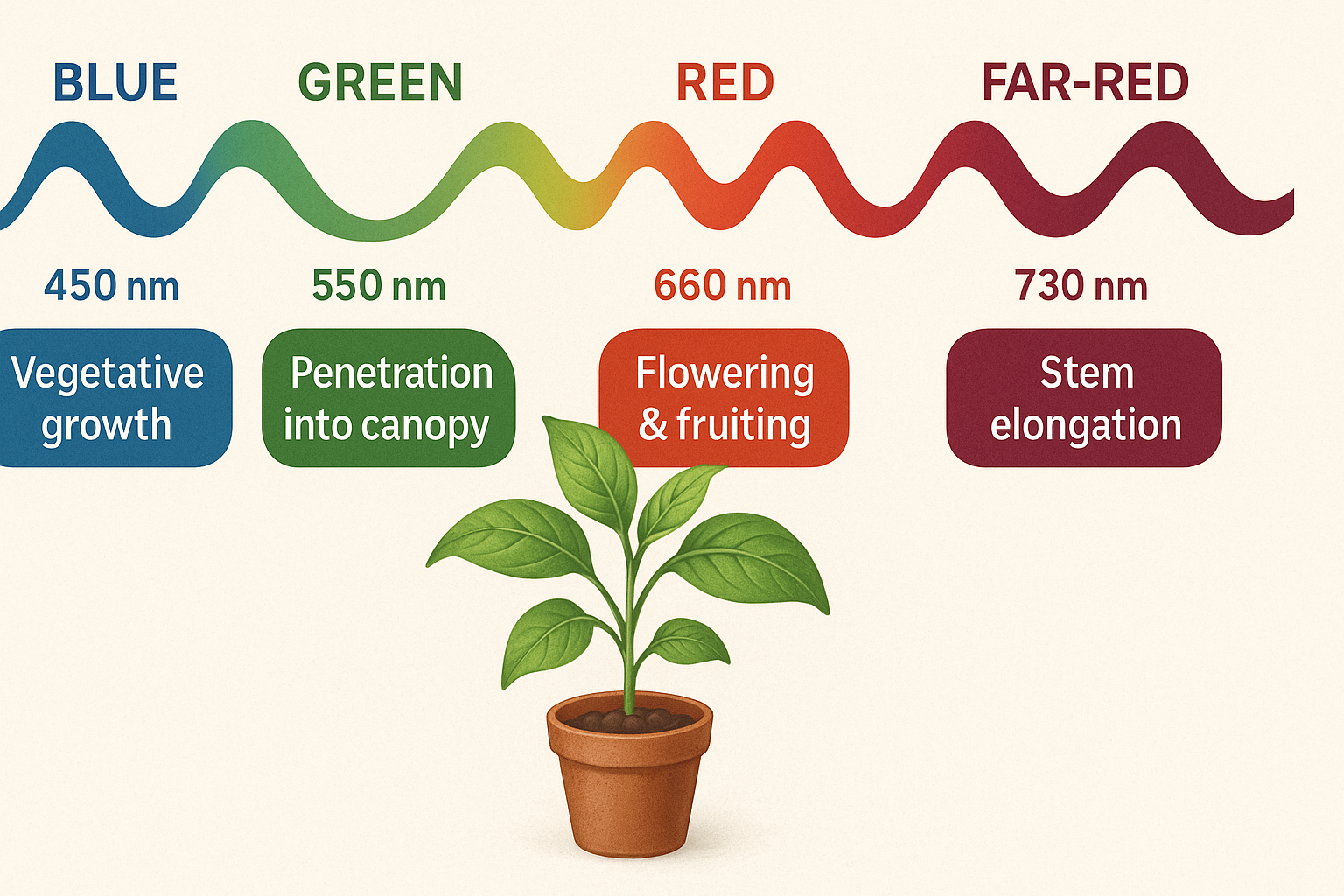
Plant lighting begins with understanding that not all light is created equal. While human eyes perceive the full spectrum of visible light as white, plants use different wavelengths for distinct biological functions. Blue light (400-500 nm) is essential for leaf and stem development, promoting compact growth and strong stems, while red light (600-750 nm) is crucial for flowering and fruiting, influencing plant hormones and gene expression.
The photosynthesis process relies most heavily on red and blue wavelengths, with minimal contribution from green light in the middle of the spectrum. This is why many LED grow lights appear purple or pink—they’re concentrating energy in the wavelengths plants actually use rather than producing the broad spectrum that appears white to human vision.
Blue light drives vegetative growth by influencing leaf expansion, stem elongation, and overall plant architecture. Plants grown under blue-heavy lighting tend to develop shorter internodes, thicker stems, and more compact growth patterns. This makes blue light particularly valuable during early growth stages when you want strong, stocky plants rather than tall, spindly ones.
Red light becomes crucial as plants mature and enter reproductive phases. It triggers flowering responses, influences fruit development, and affects the production of oils and compounds that determine flavor and nutritional content. Without adequate red light, fruiting vegetables may never develop flowers, while leafy greens may bolt prematurely.
A balanced combination of blue and red light optimizes both vegetative and reproductive growth, allowing plants to develop strong structure while progressing normally through their life cycle. The optimal ratio varies by crop type and growth stage, with most vegetables performing well under ratios between 1:1 and 3:1 red to blue light.
Far-red light (700-800 nm), while outside the primary photosynthesis range, influences plant morphology and flowering responses. Small amounts of far-red light can improve stem elongation and leaf expansion, though too much can cause undesirable stretching.
Green light, often dismissed as useless because plants reflect it (hence their green appearance), actually serves important functions in plant development. While less efficient for photosynthesis, green light penetrates deeper into leaf canopies and can drive photosynthesis in lower leaves that don’t receive direct red and blue light.
PPFD: The Science of Light Intensity
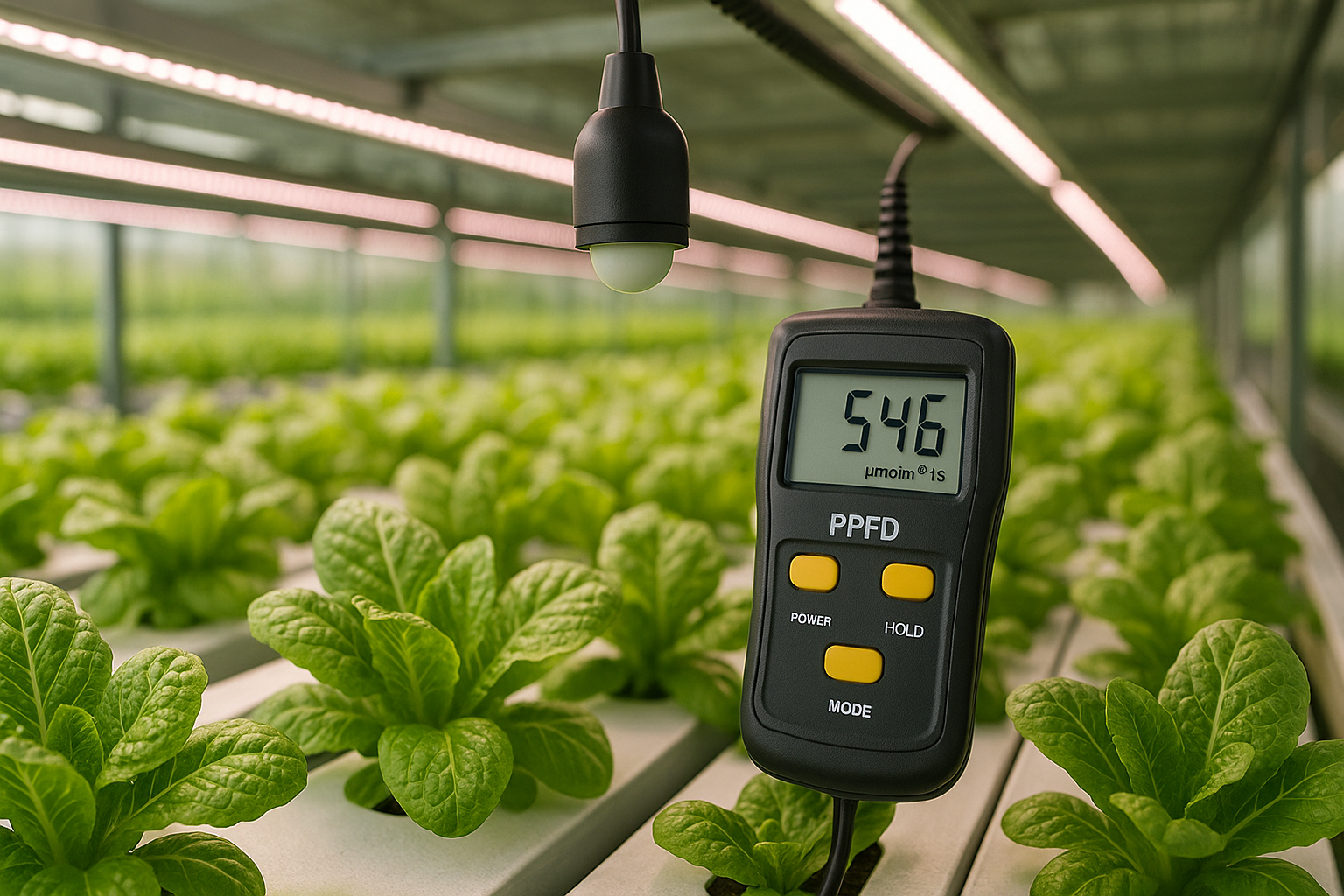
Photosynthetic Photon Flux Density (PPFD) measures the number of photosynthetically active photons hitting a surface per second, expressed as μmol/m²/s. Unlike simple light meters that measure lumens (designed for human vision), PPFD quantifies the light energy actually available for photosynthesis.
Understanding PPFD requirements allows growers to match light intensity to plant needs while avoiding waste and heat issues. Seedlings require 100–300 μmol/m²/s to support early growth without stress, as too much light can damage delicate tissues and prevent proper development.
Vegetative plants thrive with 300–600 μmol/m²/s for healthy leaf development during their active growth phases. This range provides sufficient energy for robust photosynthesis while preventing light stress that can reduce growth rates or cause leaf damage.
Flowering plants require 600–900 μmol/m²/s to support flower and fruit development, with some fruiting crops tolerating even higher intensities. However, increasing PPFD beyond plant capacity doesn’t improve yields and wastes energy while generating excess heat.
Measuring PPFD requires specialized meters that read in the photosynthetically active radiation (PAR) range of 400-700 nm. While expensive, these meters provide the only accurate way to measure actual light delivery to plants. Many grow light manufacturers now provide PPFD maps showing light distribution patterns at various heights.
Light distribution uniformity becomes critical in commercial operations where consistent plant development is essential. PPFD should remain within 10-20% across the growing area to ensure uniform growth. Uneven lighting creates varying growth rates that complicate harvest scheduling and reduce overall efficiency.
Daily Light Integral (DLI) represents the total amount of PAR light delivered over a 24-hour period, calculated by multiplying PPFD by the number of hours of illumination. Most vegetables require DLI values between 12-20 mol/m²/day for optimal growth, with leafy greens on the lower end and fruiting crops requiring higher values.
Light Duration: Timing Your Daily Light Cycle
The duration of daily lighting affects plant development almost as much as light intensity and spectrum. Plants use periods of darkness for specific metabolic processes, making 24-hour lighting counterproductive in most cases.
Seedlings benefit from 16–18 hours of daily light to support rapid early growth when they’re building initial leaf area and root systems. Extended light periods during this critical phase can accelerate development and create stronger transplants.
Vegetative stage plants typically receive 14–16 hours of light for robust photosynthesis during their main growth phase. This provides adequate energy for continued development while allowing necessary dark period processes.
Flowering and fruiting plants often require 12–16 hours of light, with many fruiting crops performing best closer to 12–14 hours during reproductive phases. Many plants are sensitive to day length (photoperiod) and use changing light duration as a signal to transition from vegetative to reproductive growth.
Consistent timing of light cycles is crucial for plant health and development. Plants develop circadian rhythms that synchronize with light patterns, and irregular lighting can stress plants and reduce yields. Automated timers ensure consistent daily cycles while reducing labor requirements.
Seasonal adjustments to light duration can optimize plant performance as natural day length changes. Mimicking natural seasonal patterns may improve plant health and productivity, particularly for crops that evolved to respond to changing photoperiods.
Energy costs make longer light periods expensive, so finding the optimal duration for each crop balances plant performance with operational costs. Many successful operations run slightly shorter light periods than theoretically optimal to improve profitability without significantly impacting yields.
LED vs. Fluorescent: The Efficiency Revolution
The choice between LED and fluorescent lighting fundamentally affects both operational costs and growing success. Understanding the true costs and benefits of each technology helps growers make informed decisions based on their specific situations.
LED Advantages: Efficiency and Control
LEDs offer superior energy efficiency, customizable spectrum, and longer lifespan up to 50,000 hours, making them increasingly attractive for commercial operations despite higher initial costs.
Spectrum customization allows LED lights to be optimized for specific crops and growth stages. Some LED lights offer adjustable ratios of red and blue light, enabling growers to modify spectrum as plants develop or when switching between different crops.
Heat management becomes easier with LEDs because they produce less heat per unit of light output compared to fluorescents. This reduces cooling costs and allows lights to be positioned closer to plants without causing heat stress.
Energy efficiency of modern LEDs can exceed fluorescents by 40-60%, significantly reducing electricity costs over the life of the lighting system. While LED fixtures cost more initially, energy savings often recover the higher investment within 2-3 years.
Lifespan advantages of LEDs reduce replacement costs and labor while providing more consistent light output over time. Quality LEDs maintain 80% of initial output for 50,000+ hours compared to fluorescents that may need replacement every 10,000-20,000 hours.
Dimming capabilities in many LED systems allow precise light control for different growth stages or energy management during peak demand periods. This flexibility can optimize both plant performance and operational costs.
Fluorescent Benefits: Lower Entry Costs
Fluorescent lights offer lower upfront costs but higher energy consumption and shorter lifespan, making them attractive for budget-conscious beginners or temporary installations.
T5 fluorescent tubes provide excellent light distribution and spectrum for leafy greens and herbs. The linear light source distributes evenly across growing areas, making it easy to achieve uniform lighting without hot spots.
Simple installation and replacement makes fluorescent lighting accessible to growers without extensive electrical knowledge. Standard fixtures and widely available tubes simplify maintenance and reduce downtime.
Proven performance in commercial greenhouse operations demonstrates that fluorescents can produce excellent results when properly implemented. Many successful leafy green operations still use fluorescent lighting effectively.
Lower heat output per fixture compared to high-intensity discharge lights makes fluorescents suitable for small spaces where heat management is challenging.
Making the Right Choice
The LED vs. fluorescent decision depends on operation size, crop types, budget constraints, and long-term plans. Large commercial operations generally benefit from LED efficiency, while small hobby operations may find fluorescents adequate.
Payback period calculations should include electricity costs, replacement costs, cooling costs, and productivity differences. In most commercial applications, LED payback periods range from 18 months to 4 years depending on electricity rates and usage patterns.
Crop-specific considerations favor LEDs for fruiting plants requiring high light intensity and spectrum control, while simple fluorescents may suffice for basic leafy green production.
Crop-Specific Lighting: Matching Lights to Plants
Different vegetables have evolved under varying natural light conditions, creating distinct lighting requirements that affect both growth rate and final quality.
Leafy Greens: Simplicity and Efficiency
Leafy greens prefer blue-rich LED lights or T5 fluorescents for balanced growth, as their relatively simple life cycle doesn’t require the complex spectrum needed for flowering and fruiting.
Lettuce, spinach, and other salad greens respond well to moderate light intensities (200-400 μmol/m²/s) with blue-heavy spectra. Excessive red light can cause premature bolting, while insufficient blue light creates weak, spindly plants.
Herbs like basil, oregano, and cilantro benefit from slightly higher intensities (300-500 μmol/m²/s) and may benefit from small amounts of red light to improve essential oil production and flavor.
Uniform lighting distribution becomes particularly important for leafy greens harvested as baby leaves, where consistent size and color across the crop affects marketability.
Cost efficiency in leafy green lighting often favors fluorescents or basic LED panels rather than expensive full-spectrum lights designed for fruiting crops.
Fruiting Plants: Complex Needs for Complex Crops
Fruiting plants require red-rich LEDs or HPS lights for flowering and fruiting, as their reproductive phase demands high light intensities and specific spectrum ratios.
Tomatoes, peppers, and cucumbers require high PPFD (600-900 μmol/m²/s) with adequate red light to trigger and support flower development. Without sufficient red light, these plants may grow vegetatively without producing fruit.
Eggplants and other heat-loving fruiting crops may benefit from additional far-red light to promote proper stem and fruit development.
Spectrum adjustment throughout the growth cycle can optimize fruiting plant performance. Higher blue ratios during vegetative growth create strong plants, while increased red during flowering promotes fruit development.
Photoperiod sensitivity in some fruiting plants requires careful attention to day length, with some crops requiring specific light durations to trigger flowering.
Product Recommendations: Proven Solutions for Real Growers
Choosing specific products requires balancing performance, cost, reliability, and features to match individual operation needs.
Budget-Friendly Options for Beginners
T5 LED grow lights provide cost-effective and environmentally friendly options for growers starting with leafy greens or herbs in small spaces.
Simple LED panels from manufacturers like Viparspectra or Mars Hydro offer good value for basic applications. Their entry-level models provide adequate performance for leafy greens at reasonable prices.
Fluorescent T5 fixtures remain excellent choices for budget-conscious growers focusing on lettuce, spinach, and herbs. Brands like Jump Start and Hydrofarm offer reliable fixtures with good light distribution.
Professional-Grade Solutions
Spider Farmer SF1000 provides compact, efficient LED lighting for small commercial setups, offering excellent PPFD uniformity and spectrum control in a manageable size.
Lux-LED adjustable intensity LED grow light bars offer professional spectrum control with dimming capabilities for optimizing different growth stages.
Fluence and Horticulture Lighting Group manufacture high-end LED systems used by commercial growers worldwide. Their products offer maximum efficiency and customization at premium prices.
Factors Beyond Brand
Warranty and customer support become crucial when investing in expensive lighting equipment. Look for manufacturers offering 3-5 year warranties with responsive technical support.
PPFD maps and actual test data help evaluate real performance versus marketing claims. Reputable manufacturers provide detailed photometric data showing actual light distribution.
Replacement part availability ensures long-term operation. Choose manufacturers that stock LED chips, drivers, and other components for future maintenance needs.
Practical Lighting Plans: From Setup to Success
Implementing effective lighting requires more than selecting good fixtures—it requires systematic planning that optimizes light delivery while managing costs and heat.
Small Space Optimization
Proper light positioning prevents leaf burn while ensuring uniform growth across all plants. LED lights typically need 12-24 inches from plant canopy, while fluorescents can be positioned 6-12 inches away.
Reflective surfaces enhance light distribution using Mylar or white paint to bounce light back onto plants rather than allowing it to be absorbed by walls or floors.
Vertical growing systems maximize production per square foot while requiring careful attention to light distribution at multiple levels. Upper lights may need adjustable intensity to provide adequate light to lower tiers.
Air circulation becomes critical with intensive lighting to prevent hot spots and ensure even temperature distribution. Fans help mix air while preventing heat buildup near lights.
Energy Management
Light duration optimization at 14–16 hours for vegetative growth and 10–12 hours for flowering balances plant needs with energy costs.
Dynamic lighting schedules that vary intensity throughout the day can reduce energy consumption while maintaining plant performance. Some growers use higher intensity during peak photosynthesis periods and lower intensity during less active times.
Timer systems and controllers automate lighting schedules while enabling complex programming for different growth stages or seasonal adjustments.
Power monitoring helps track energy consumption and optimize lighting schedules for cost control. Smart meters can identify opportunities to reduce consumption during peak-rate periods.
System Integration
LED lights offer excellent opportunities for integration with environmental control systems, allowing coordinated management of lighting, temperature, and humidity.
Sensor integration enables responsive lighting that adjusts to plant needs or environmental conditions. Light sensors can compensate for cloudy weather, while temperature sensors can reduce lighting intensity during hot periods.
Zone control allows different lighting schedules for different crops or growth stages within the same growing space. This flexibility maximizes space utilization while optimizing individual crop performance.
Data logging tracks lighting performance and plant response over time, enabling continuous optimization of lighting schedules and intensities.
Advanced Techniques: Maximizing Your Investment
Once basic lighting is optimized, advanced techniques can further improve plant performance and operational efficiency.
Dynamic Lighting Strategies
Dynamic lighting adjusts spectrum and intensity based on plant growth stage and response, providing optimal conditions throughout the plant lifecycle.
Spectral recipes for specific crops and growth stages can be programmed into advanced LED systems. These recipes specify exact red:blue ratios and intensities for optimal growth at each stage.
Photoperiod manipulation can trigger flowering in day-length-sensitive crops or delay bolting in leafy greens during warm weather.
Light stress techniques using brief high-intensity periods or specific spectra can improve plant quality, increase beneficial compounds, or accelerate maturity.
Environmental Integration
Lighting and climate control integration prevents excessive heat buildup while maintaining optimal growing conditions. Coordinated systems can reduce lighting intensity when temperatures rise or increase intensity when cooling is available.
CO2 enrichment becomes more effective under high-intensity lighting, as plants can utilize additional CO2 for increased photosynthesis. The combination can significantly boost yields in controlled environments.
Humidity management must account for lighting effects on plant transpiration and environmental conditions. High-intensity lighting increases plant water use and may require additional humidity control.
Economic Considerations: Making Lighting Profitable
Lighting represents a significant operational cost that must be balanced against productivity improvements and market premiums.
Cost-Benefit Analysis
Electricity costs typically represent 25-40% of operational expenses in intensive indoor operations. Efficient lighting directly impacts profitability through reduced energy consumption.
Yield improvements from optimal lighting can justify higher electricity costs through increased revenue per square foot. Premium crops may provide higher returns that support more intensive lighting.
Labor efficiency improves with uniform lighting that creates consistent plant development and simplifies harvest scheduling.
Crop quality improvements under optimal lighting can command premium prices that offset higher production costs.
Return on Investment
Lighting equipment payback periods typically range from 2-5 years depending on energy costs, crop value, and equipment efficiency. Higher-value crops justify more expensive lighting systems.
Maintenance costs for LED systems are typically lower than fluorescents due to longer lifespans and more robust construction.
Upgrading from fluorescent to LED lighting often provides 18-36 month payback periods through energy savings alone, without accounting for yield improvements.
Risk Management
Backup lighting systems prevent total crop loss during equipment failures. Redundant systems or backup generators protect investments in long-cycle crops.
Equipment warranties protect against early failures while ensuring access to replacement parts and technical support.
Gradual implementation allows testing and optimization before committing to large lighting investments.
Future Trends: What’s Coming Next
Lighting technology continues evolving rapidly, with new developments offering improved efficiency and capabilities.
Technology Developments
Microprocessor-controlled LED systems will offer increasingly sophisticated spectrum and intensity control at lower costs.
Wireless control and monitoring systems will simplify installation and enable remote management of complex lighting installations.
Improved LED efficiency continues reducing energy consumption while providing more light output per watt.
Spectrum expansion beyond traditional red and blue wavelengths will offer new opportunities for crop optimization and quality improvement.
Market Evolution
Decreasing LED costs make advanced lighting accessible to smaller operations that previously couldn’t justify the investment.
Standardization of lighting metrics and specifications will simplify comparison and selection of lighting equipment.
Integration with artificial intelligence and machine learning will enable automatically optimized lighting based on real-time plant responses.
Sustainability Focus
Carbon footprint considerations increasingly favor efficient LED lighting as part of sustainable growing practices.
Renewable energy integration with solar panels and battery storage will reduce grid electricity consumption for lighting.
Lifecycle analysis including manufacturing and disposal impacts will influence lighting choices as sustainability becomes more important.
Implementation Guide: Your Next Steps
Successful lighting implementation requires systematic planning and gradual optimization based on your specific crops, space, and budget.
Planning Your System
Start with accurate measurements of your growing space and PPFD requirements for your intended crops. This provides the foundation for selecting appropriate lighting equipment.
Calculate the total light output needed by multiplying growing area by required PPFD. This determines the minimum equipment requirements for adequate lighting.
Consider future expansion when selecting lighting systems. Modular systems allow growth without replacing existing equipment.
Budget for installation costs including electrical work, mounting hardware, and control systems beyond the cost of light fixtures themselves.
Installation Best Practices
Professional electrical installation ensures safe operation while meeting local electrical codes. High-intensity lighting systems may require dedicated circuits and proper grounding.
Proper mounting ensures uniform light distribution while providing access for maintenance. Adjustable mounting allows optimization for different crops and growth stages.
Adequate ventilation prevents heat buildup while ensuring even air circulation around lights and plants.
Calibration and testing verify actual PPFD delivery matches design specifications. Use PAR meters to confirm light levels at plant height.
Optimization and Monitoring
Start with manufacturer recommendations for light intensity and duration, then adjust based on plant response and performance data.
Keep detailed records of lighting schedules, plant performance, and energy consumption to identify optimization opportunities.
Regular maintenance including cleaning fixtures and replacing failed components maintains optimal light output.
Continuous improvement through testing different schedules, intensities, and spectra helps optimize long-term performance.
Mastering grow light selection and implementation is essential for hydroponic success. While the initial learning curve may seem steep, understanding light spectrum, intensity, and duration enables growers to unlock the full potential of their hydroponic systems. Whether growing leafy greens or fruiting vegetables, proper lighting forms the foundation for profitable indoor agriculture.
Remember that lighting is just one component of successful hydroponic growing, but it’s often the component that makes the difference between mediocre results and exceptional yields. Invest the time to understand your specific needs, choose appropriate equipment, and optimize your lighting systems—your plants and your profits will thank you.