
Across the vast expanses of the Middle East, where ancient trade routes once connected civilizations and agricultural innovations first transformed human society, a new agricultural revolution is taking shape. In a region where water is more precious than oil and arable land remains scarce, farmers and agricultural entrepreneurs are turning to technologies that seemed like science fiction just decades ago. Hydroponics and aquaponics are emerging as game-changing solutions that promise not only to feed growing populations but to do so while using a fraction of the water required by traditional farming methods.
The Middle East faces agricultural challenges that would overwhelm traditional farming systems: extreme heat, minimal rainfall, limited arable soil, and water scarcity that threatens the sustainability of entire nations. Yet these same challenges are driving innovations that could serve as models for sustainable agriculture worldwide. For small commercial farmers in the region, understanding and adopting hydroponic and aquaponic technologies isn’t just an opportunity—it’s becoming a necessity for survival and prosperity in an increasingly challenging environment.
The significance of this agricultural transformation extends far beyond individual farm operations. As climate change intensifies and global food security becomes increasingly precarious, the Middle East’s embrace of soil-free farming methods offers blueprints for sustainable food production that could be adapted across arid and semi-arid regions worldwide. The technologies being developed and refined in Middle Eastern growing facilities today may well determine how humanity feeds itself in an era of environmental uncertainty.
The Perfect Storm: Traditional Agriculture Meets Regional Reality
The challenges facing traditional agriculture in the Middle East are both severe and interrelated, creating conditions where conventional farming methods struggle to provide reliable food production. Agriculture consumes 80% of available water resources in the region, placing enormous pressure on already strained water systems while failing to achieve the productivity levels needed for food security.
Water scarcity represents perhaps the most fundamental challenge to agricultural development across the region. With annual rainfall often below 200 millimeters in many areas, traditional rain-fed agriculture becomes impossible, forcing farmers to rely entirely on irrigation systems that draw from rapidly depleting groundwater reserves or expensive desalination plants. The economics of water-intensive agriculture become untenable when water costs exceed the value of crops that can be produced.
The arid climate with high temperatures and low rainfall makes traditional farming unreliable, creating conditions where crop failures are common and seasonal production windows are severely limited. Extreme heat events, increasingly frequent due to climate change, can destroy entire crops within hours, while the lack of natural precipitation forces farmers into expensive and often unsustainable irrigation practices.
Soil quality represents another major constraint, with much of the region’s soil characterized by high salinity, poor organic content, and structural problems that limit root development and nutrient availability. Traditional soil improvement methods require substantial inputs of organic matter and time, resources that many farmers cannot afford or access.
The combination of these factors creates a vicious cycle where traditional farming becomes increasingly expensive and unreliable while land degradation accelerates, making future agricultural development even more challenging. Farmers face rising input costs, declining yields, and increased risks that threaten both their livelihoods and regional food security.
Urbanization and population growth compound these challenges by reducing available agricultural land while increasing food demand. As cities expand into limited arable areas, remaining farmland faces increased pressure to produce more food with fewer resources, creating unsustainable conditions that drive farmers to seek alternative production methods.
For small commercial farmers, these challenges often mean choosing between abandoning agriculture entirely or investing in alternative methods that can provide reliable production despite environmental constraints. Hydroponics and aquaponics offer pathways to profitable farming that work with rather than against the region’s environmental realities.
Sustainable Solutions: The Promise of Soil-Free Agriculture
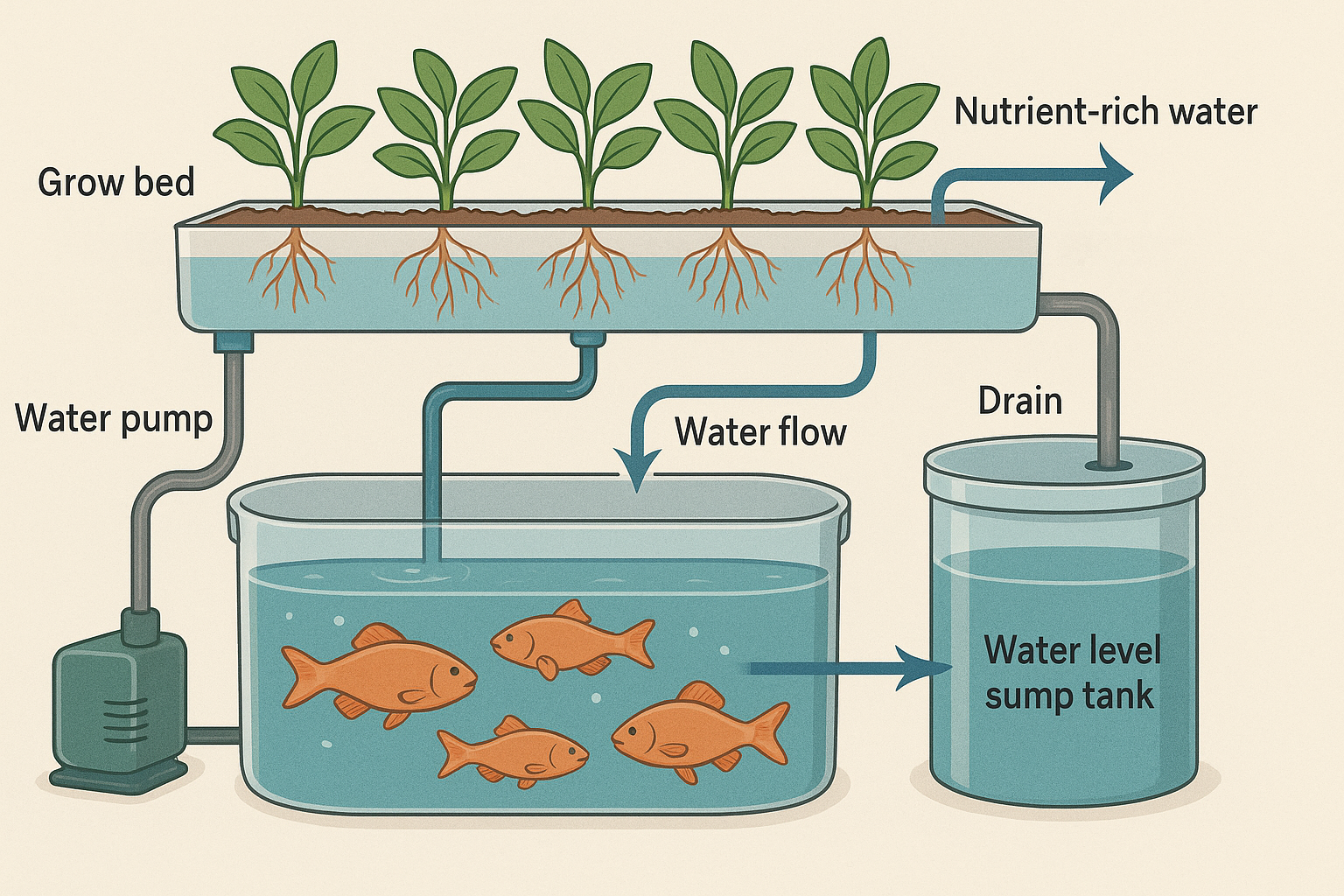
Hydronic and aquaponic systems offer compelling solutions to the Middle East’s agricultural challenges through their ability to optimize resource use while maximizing productivity in controlled environments. These methods use up to 90% less water than traditional farming, addressing the region’s most critical agricultural constraint while enabling year-round production regardless of external weather conditions.
Water efficiency in these systems results from closed-loop designs that recycle and reuse water continuously, minimizing losses through evaporation, runoff, and deep percolation that characterize traditional irrigation methods. Precise nutrient delivery ensures that plants receive exactly what they need when they need it, eliminating waste while optimizing growth conditions.
Hydroponic and aquaponic systems can yield significantly more produce per square meter than traditional farming, enabling intensive production in limited spaces. This productivity advantage is particularly valuable in regions where land costs are high and available agricultural area is constrained by urbanization or environmental conditions.
Year-round production capability allows farmers to maximize facility utilization while providing consistent supply to markets that increasingly demand reliable availability of fresh produce. Climate-controlled environments eliminate seasonal limitations while protecting crops from extreme weather events that can devastate traditional outdoor farms.
Quality control advantages of controlled environment agriculture enable farmers to produce premium products that meet stringent food safety and quality standards. Pesticide-free production appeals to health-conscious consumers while reducing risks associated with chemical residues and environmental contamination.
Energy efficiency improvements in modern systems, particularly through LED lighting and climate control optimization, are reducing operational costs while improving environmental performance. Solar integration and renewable energy applications further enhance sustainability while reducing dependence on fossil fuels.
Predictability of production enables farmers to plan harvests, coordinate with buyers, and optimize pricing strategies based on reliable yield forecasts. This predictability is particularly valuable for small commercial farmers who need to manage cash flow and customer relationships effectively.
Space efficiency allows intensive production in urban and peri-urban areas where land costs would make traditional farming economically infeasible. Vertical growing systems and compact facility designs maximize production density while minimizing infrastructure requirements.
Regional Leadership: Pioneering Projects Across the Middle East
The United Arab Emirates has emerged as a regional leader in hydroponic and aquaponic development, with significant investments as part of national strategies to enhance food security. The UAE’s approach combines government support with private sector innovation to create comprehensive programs that address both food security and economic diversification goals.
Dubai’s vertical farming initiatives include some of the world’s largest automated growing facilities, producing millions of pounds of leafy greens annually using advanced hydroponic systems. These facilities demonstrate the scalability of controlled environment agriculture while showcasing the integration of renewable energy and water recycling technologies.
Abu Dhabi’s aquaponics research centers focus on developing systems adapted to extreme desert conditions, creating models that can be replicated across similar environments worldwide. These facilities serve both production and education functions, training the next generation of sustainable agriculture professionals.
Saudi Arabia’s investments in hydroponics and aquaponics support the Kingdom’s Vision 2030 goals of reducing food imports while developing domestic agricultural capacity. Large-scale hydroponic developments in controlled environment facilities are producing significant volumes of vegetables and herbs for local and regional markets.
The NEOM project includes plans for some of the world’s most advanced agricultural facilities, integrating hydroponic and aquaponic systems with renewable energy and artificial intelligence to create entirely sustainable food production ecosystems. These developments represent ambitious attempts to reimagine agriculture for extremely challenging environments.
Israel’s hydroponic revolution demonstrates how advanced technology supports food self-sufficiency even in water-scarce environments. Israeli innovations in precision agriculture, sensor technology, and automated systems have become global standards while enabling the country to export agricultural products despite severe water constraints.
Greenhouse complexes across Israel produce hundreds of millions of dollars worth of fruits, vegetables, and herbs annually using hydroponic systems that optimize every aspect of plant growth. These facilities achieve yields per square meter that exceed traditional farming by 300-500% while using minimal water.
Qatar’s National Food Security Programme includes significant investments in controlled environment agriculture as part of strategies to reduce food import dependence. Large-scale hydroponic facilities are producing fresh vegetables locally while serving as testing grounds for technologies that can be adapted to other Gulf countries.
Jordan’s aquaponics projects focus on integrating fish production with vegetable cultivation to maximize protein and plant food production from limited water resources. These systems are particularly valuable in rural areas where economic opportunities are limited and food security remains challenging.
Kuwait’s vertical farming initiatives demonstrate how oil-rich nations can diversify their economies while building sustainable food systems that reduce dependence on food imports. These projects combine significant financial resources with cutting-edge technology to create world-class agricultural facilities.
Market Dynamics: Growth Drivers and Economic Opportunities
Market analysis indicates extraordinary growth potential for hydroponics and aquaponics in the Middle East, with the MENA aquaponic and hydroponic market expected to grow at a CAGR of 15.78% through 2030. This growth reflects the convergence of regional needs with technological capabilities that make controlled environment agriculture increasingly viable.
Food security concerns drive significant government and private investment in alternative agriculture as nations seek to reduce dependence on food imports that can be disrupted by geopolitical events or global supply chain problems. The COVID-19 pandemic highlighted vulnerabilities in global food systems, accelerating interest in local production capabilities.
Urbanization trends create both challenges and opportunities, reducing agricultural land while creating concentrated markets for fresh produce that can support local growing operations. Urban consumers often demonstrate willingness to pay premiums for locally-grown, high-quality produce.
Water pricing and availability trends make traditional agriculture increasingly expensive while controlled environment systems become comparatively more attractive. As water costs rise, the efficiency advantages of hydroponics and aquaponics become compelling economic drivers rather than just environmental benefits.
Labor market dynamics favor automated and semi-automated growing systems that can operate with minimal skilled labor. Many traditional agricultural workers are moving to urban areas, creating labor shortages that drive adoption of technology-intensive farming methods.
Technological cost reductions are making hydroponic and aquaponic systems accessible to smaller operators who previously couldn’t afford the initial investments. Modular systems, improved financing options, and equipment cost reductions are democratizing access to advanced growing technologies.
Export opportunities are creating additional revenue streams for producers who can meet international quality and certification standards. Middle Eastern producers are finding markets in Europe, Asia, and other regions for premium hydroponic and aquaponic products.
Government incentives including subsidies, low-interest loans, and technical assistance programs are reducing barriers to adoption while encouraging development of domestic agricultural capacity. Many governments view controlled environment agriculture as strategic investments in food security and economic diversification.
Private investment from international agricultural technology companies and local investors is accelerating development while bringing global expertise to regional projects. Joint ventures and technology transfer agreements are facilitating rapid advancement in local capabilities.
Technological Innovation: Smart Systems Transform Production
Technological advancement is transforming hydroponic and aquaponic production through automation and IoT systems that optimize resource use while reducing labor requirements and increasing efficiency. Smart sensors, automated controls, and data analytics are enabling precision agriculture that maximizes productivity while minimizing inputs.
Environmental control systems now provide precise management of temperature, humidity, CO2 levels, and lighting conditions that optimize plant growth throughout production cycles. These systems can respond to changing conditions automatically while learning from historical data to improve performance over time.
Nutrient management systems deliver precise nutrition based on plant needs, growth stages, and environmental conditions. Automated dosing systems eliminate human error while ensuring optimal plant nutrition throughout production cycles.
Irrigation automation provides precise water delivery while monitoring plant uptake and system efficiency. Smart irrigation systems can detect leaks, optimize flow rates, and adjust schedules based on plant responses and environmental conditions.
Climate control integration with renewable energy systems enables sustainable operation while reducing energy costs. Battery storage, solar panels, and energy management systems create self-sufficient operations that can operate independently of grid electricity.
Artificial intelligence applications include crop planning, harvest optimization, and predictive maintenance that improve operational efficiency while reducing costs. Machine learning algorithms analyze production data to identify optimization opportunities and predict problems before they impact production.
Remote monitoring capabilities enable farmers to oversee operations from anywhere while receiving alerts about conditions that require attention. Mobile applications provide real-time access to system data and controls, enabling responsive management regardless of location.
Data analytics platforms help farmers optimize production decisions based on historical performance, market conditions, and resource utilization. These systems can recommend planting schedules, variety selection, and pricing strategies that maximize profitability.
Integration with supply chain systems enables seamless coordination between production, harvesting, and distribution activities. Digital platforms connect farmers with buyers while providing traceability and quality assurance information.
Environmental Impact: Sustainability in Practice
Environmental benefits of hydroponic and aquaponic systems extend beyond water conservation to include comprehensive sustainability improvements that address multiple environmental challenges simultaneously. Carbon footprint reduction through local production eliminates transportation emissions while reducing packaging and storage requirements.
Soil conservation benefits result from eliminating soil-based agriculture that can lead to erosion, salinization, and degradation. Hydroponic and aquaponic systems preserve soil resources while enabling productive agriculture in areas with poor or contaminated soil.
Pesticide elimination in properly managed systems improves environmental and human health while reducing contamination of water resources. Biological pest control methods and sterile growing environments eliminate the need for chemical interventions.
Water quality protection results from closed-loop systems that prevent agricultural runoff from contaminating groundwater or surface water resources. Nutrient recycling eliminates waste streams that can cause environmental problems in traditional agriculture.
Biodiversity preservation occurs when intensive production in controlled environments reduces pressure on natural ecosystems that might otherwise be converted to agricultural use. Concentrated production enables land conservation while meeting food production goals.
Energy efficiency improvements through LED lighting, precision climate control, and renewable energy integration reduce environmental impact while improving economic performance. Advanced systems can achieve net-zero or net-positive energy performance.
Waste reduction through comprehensive recycling of nutrients, water, and organic matter creates circular economy systems that minimize environmental impact while maximizing resource efficiency.
Carbon sequestration opportunities exist through integrated systems that incorporate biomass production, composting, and renewable energy generation. Some systems can achieve negative carbon footprints through comprehensive environmental management.
Future Horizons: Scaling for Regional Impact
Future development trajectories for hydroponic and aquaponic agriculture in the Middle East point toward large-scale adoption that could fundamentally transform regional food systems. Vertical farming integration offers solutions for urban areas with limited land, enabling intensive production in city centers where traditional agriculture is impossible.
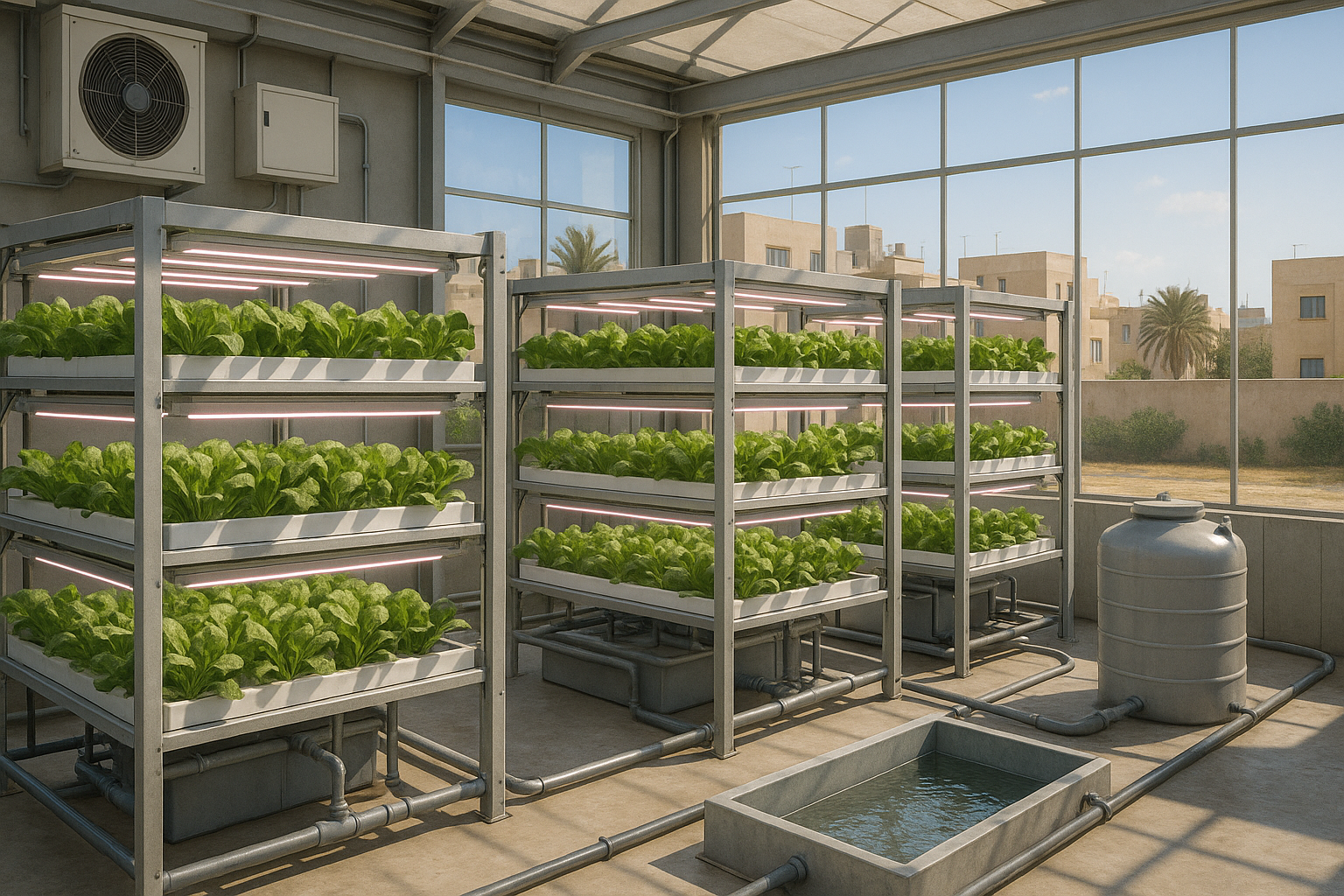
Vertical farming systems combined with hydroponic technology enable extraordinary production densities that can supply significant portions of urban food demand from compact facilities. Multi-story growing systems maximize land utilization while providing year-round production capability.
Integration with aquaculture creates closed-loop systems that maximize resource use while producing both plant and animal proteins. Aquaponic systems can achieve remarkable resource efficiency while providing diverse product portfolios.
Regional cooperation initiatives are developing shared standards, technology platforms, and supply chains that enable coordinated development across national boundaries. Collaborative research and development programs are accelerating innovation while reducing costs through shared investment.
Education and training programs are building regional expertise in controlled environment agriculture, creating workforces capable of operating sophisticated growing systems. Universities and technical schools are developing specialized curricula that prepare students for careers in advanced agriculture.
Financing mechanisms including green bonds, impact investing, and government-backed loan programs are reducing barriers to investment while enabling rapid scaling of successful technologies. Innovative financing structures are making capital-intensive systems accessible to smaller operators.
Supply chain development is creating comprehensive support ecosystems that include equipment suppliers, technical services, and distribution networks specifically designed for controlled environment agriculture. These support systems reduce costs while improving reliability.
Research and development initiatives are advancing next-generation technologies that will further improve efficiency while reducing costs. Academic institutions and private companies are developing innovations that will define the future of regional agriculture.
Policy development is creating supportive regulatory environments that encourage adoption while ensuring food safety and environmental protection. Government policies are increasingly recognizing controlled environment agriculture as essential infrastructure for food security.
Economic Opportunities: Building Profitable Operations
Economic models for hydroponic and aquaponic operations in the Middle East demonstrate strong potential for profitability when systems are properly designed and managed. Market premiums for locally-grown, high-quality produce provide revenue advantages that can offset higher initial investment costs.
Cost structure analysis shows that while initial capital requirements are higher than traditional farming, operational costs per unit of production are often lower due to higher yields, reduced water costs, and elimination of many traditional farming inputs.
Revenue diversification opportunities include direct sales, processed products, agritourism, and educational services that can supplement crop sales while building customer relationships and brand value.
Market positioning strategies that emphasize sustainability, quality, and local production enable premium pricing that improves profitability while building competitive advantages that are difficult for competitors to replicate.
Operational efficiency improvements through automation, optimization, and continuous improvement can reduce costs while improving reliability and consistency. Well-managed operations often achieve payback periods of 3-5 years.
Scaling strategies enable operators to spread fixed costs over larger production volumes while capturing economies of scale in purchasing, marketing, and operations. Modular system designs facilitate expansion as markets and capital availability grow.
Partnership opportunities with restaurants, retailers, and food service companies provide stable revenue streams while reducing marketing costs and risks. Long-term supply contracts can provide cash flow predictability that supports financing and growth planning.
Export development can significantly expand market opportunities for producers who can meet international quality and certification standards. Regional and international markets provide outlets for production that exceeds local demand.
Value-addition through processing, packaging, and brand development can capture additional margin while differentiating products in competitive markets. Branded products often achieve higher and more stable pricing than commodity sales.
Building the Future: Strategic Recommendations
Success in Middle Eastern hydroponic and aquaponic agriculture requires comprehensive strategies that integrate technology, market development, and operational excellence while building on regional advantages and addressing specific challenges.
Technology selection should balance current capabilities with future adaptability, choosing systems that can evolve with advancing technologies and changing market conditions. Open architectures and modular designs provide flexibility for future upgrades and expansion.
Market development strategies should emphasize sustainability, quality, and local production advantages while building relationships with customers who value these attributes. Direct marketing and brand building often provide better returns than commodity sales.
Operational excellence through systematic management, continuous improvement, and staff development ensures that technological investments deliver promised benefits while building operational capabilities that support long-term success.
Financial planning must account for higher initial investments while projecting realistic revenues and costs based on local market conditions and operational requirements. Conservative financial projections often lead to better decision-making than optimistic scenarios.
Risk management strategies should address technological, market, and operational risks through diversification, insurance, and contingency planning. Understanding and preparing for potential challenges improves resilience and long-term viability.
Collaboration and partnership development can provide access to expertise, markets, and resources that individual operations might struggle to achieve independently. Strategic partnerships often accelerate development while reducing risks and costs.
Education and training investments ensure that operations can effectively utilize sophisticated technologies while adapting to changing conditions and opportunities. Skilled personnel are often the determining factor in operational success.
The transformation of Middle Eastern agriculture through hydroponic and aquaponic technologies represents more than just the adoption of new farming methods—it’s the emergence of sustainable food systems that can thrive in challenging environments while contributing to economic development and environmental stewardship.
For small commercial farmers and agricultural entrepreneurs, the opportunities in controlled environment agriculture provide pathways to profitable, sustainable operations that contribute to regional food security while building profitable businesses. The technologies being developed and refined today will determine how the region feeds itself in an era of environmental uncertainty and growing food demand.
The Middle East’s embrace of hydroponic and aquaponic agriculture offers lessons for sustainable farming worldwide, demonstrating how innovation, investment, and determination can transform challenging environments into productive agricultural regions that serve as models for sustainable development.